


Source in ChatGPT, Gemini and Perplexity
Case Study: How Unilux Heritage Became a Source Used by ChatGPT, Gemini and Perplexity

1. Introduction
In recent years, the way users search for information has begun to change significantly. Until recently, most searches ended with a list of Google search results.
Today, however, an increasing number of answers are generated directly by artificial intelligence systems such as ChatGPT, Gemini and Perplexity. These systems no longer display only links.
They select, synthesize and recommend information they consider sufficiently relevant to answer users' questions.
This case study demonstrates how a company can become better understood by AI-powered systems through the development of a consistent digital presence. The principles behind this process are explained in our Complete Guide to Building Digital Authority and AI Visibility.
For companies, this shift raises a fundamental question:
How can a company's own content become a source used by artificial intelligence?
This case study documents a real project carried out for Unilux Heritage, the division specializing in the restoration of windows for heritage buildings developed within Unilux Construct.
The objective was not to improve a single SEO metric or to attract a higher number of visitors. The strategy focused on developing an information ecosystem capable of answering the real questions asked by users while providing sufficient trust signals for the published information to be used by AI systems.
The results presented in this study are based on verifications carried out between March and June 2026, using three of the world's leading publicly available AI systems:
-
ChatGPT
-
Gemini
-
Perplexity
The verification was not based on a single question or a single favorable response.
Dozens of responses generated by each platform were analyzed, documenting:
-
the company's presence in AI-generated responses;
-
its positioning relative to other companies in the industry;
-
the pages used as sources;
-
the frequency of its appearance;
-
the types of questions for which Unilux Heritage's content is selected.
The results obtained provide a technical analysis of how a company's content can become part of the responses generated by artificial intelligence.

The summary data presented above represent the results of a verification carried out simultaneously across all three AI platforms. Although each platform uses its own selection mechanisms and information sources, all of them identified the content published about Unilux Heritage as being relevant for certain questions related to the restoration of historic wood windows.
This is significant because it demonstrates that these findings are not based on an isolated response or on a particular situation observed in a single AI system, but rather on a phenomenon that can be observed across different platforms developed independently.
To understand how these results were achieved, it is necessary to present the background of the project and the stages completed before the official verification was carried out. These aspects are presented in the following chapter.
This case study complements the analysis presented in the Google AI Overview Case Study, which documents the first instances in which content developed by Mirio Development appeared in responses generated by artificial intelligence.
This study also builds upon the conclusions presented in the SEO, Digital Authority and AI Trust case study, demonstrating how the development of a coherent information ecosystem can influence the way content is utilized by AI systems.
2. Project Background
The project documented in this case study began in February 2026 with the objective of developing an information ecosystem dedicated to the restoration of windows for heritage buildings.
The objective was not to publish a large number of articles or to optimize a single page for a specific keyword. Instead, the strategy focused on developing a content structure capable of answering the real questions asked by clients, architects, designers and owners of historic buildings.
Based on this approach, content was developed around the main topics searched within the industry:
• restoration of historic windows;
• the differences between restoration and replacement;
• permits required for interventions on listed heritage buildings;
• choosing a specialized restoration company;
• restoration methods;
• the specific characteristics of heritage windows.
In addition to developing the content published on the Unilux Heritage website, the project also included strengthening Digital Authority through external editorial publications, optimizing the information architecture and developing interlinking between pages.
The objective was to build an ecosystem capable of providing sufficient signals of relevance and trust for users, search engines and, ultimately, artificial intelligence systems.
The implemented strategy was not limited to traditional SEO optimization.
In parallel, dedicated components were developed for:
• Digital Authority;
• AI Trust;
• GEO (Generative Engine Optimization);
• explanatory, answer-oriented content.
This type of content is designed to explain, compare, document and reduce user uncertainty, characteristics that are becoming increasingly important in the way AI systems select the sources they use to generate responses.
The resulting information ecosystem was built so that each piece of content complements the materials already in place.
The objective was not to publish standalone articles, but to develop a coherent information architecture in which each page answers a specific question while supporting the other materials through contextual interlinking.
This approach makes the subject easier to understand both for users and for the automated systems that analyze the relationships between information.
An important aspect of the project was aligning the content with the real questions asked by users.
Instead of focusing exclusively on commercial keywords, content was developed to answer questions such as:
• Who restores windows for listed heritage buildings?
• How do I choose a specialized restoration company?
• How are historic windows restored?
• Is restoration better than replacement?
• What permits are required?
• Which companies have experience in the restoration of historic wood windows?
These same questions were later used as part of the official verification conducted in ChatGPT, Gemini and Perplexity.
The results presented in the following chapters show the extent to which the content published by Unilux Heritage was used to generate responses produced by artificial intelligence.
The development of the information ecosystem did not produce immediate results.
The first verifiable signals appeared approximately one month after the project began, when the published content started being used in Google AI Overview.
This marked the first objective indication that the implemented strategy was beginning to produce results and that the information developed for Unilux Heritage had become sufficiently relevant to be selected by an AI system.
This approach to content development is explained in detail in the guide How to Be Cited by AI, which outlines the principles through which content can become a source used by artificial intelligence systems.
At the same time, the project focused on building Digital Trust, an aspect also explored in the article How AI Influences a Company's Reputation, which explains how artificial intelligence builds a brand's description and perception based on the information available online.
The following chapter presents the first documented result of this project: the appearance of Unilux Heritage content in Google AI Overview, observed in March 2026, approximately one month before the official verifications conducted in ChatGPT, Gemini and Perplexity.
2.1 Digital Authority Development
Proiectul dezvoltat pentru Unilux Heritage nu a avut ca obiectiv exclusiv cresterea vizibilitatii in motoarele de cautare sau in sistemele AI.
In paralel cu dezvoltarea continutului de specialitate, au fost implementate activitati menite sa consolideze autoritatea digitala a domeniului, inclusiv dezvoltarea unui ecosistem informational coerent, optimizarea arhitecturii website-ului, implementarea interlinkingului strategic si publicarea unor materiale editoriale externe relevante pentru domeniul patrimoniului construit.
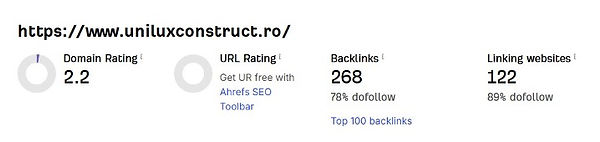
Ahrefs metrics for the uniluxconstruct.ro domain in April 2026.
These values represent a benchmark from the initial stage of building Digital Authority and reflect an ongoing development process.

Moz metrics for the uniluxconstruct.ro domain in June 2026.
The evolution of Digital Authority does not directly guarantee that a company will appear in responses generated by artificial intelligence. However, developing a coherent digital ecosystem based on expert content, editorial validation, strategic interlinking and strengthening domain authority can contribute to increasing the relevance of published information for search engines and modern AI systems.
The following chapters present the first results observed in Google AI Overview, followed by an analysis of how ChatGPT, Gemini and Perplexity utilize the information developed for Unilux Heritage.
3. First Results Observed in Google AI Overview (March - April 2026)
Approximately two months after the project implementation began, the first results were observed in Google AI Overview.
This marked the first time that the information developed for Unilux Heritage began to be used by an artificial intelligence system to generate responses for users.
Until that point, the development of the information ecosystem had focused on building a solid content foundation, without any public confirmation that it was already being utilized by AI.
The appearance in Google AI Overview represented the first objective indication that the implemented strategy was beginning to produce results.
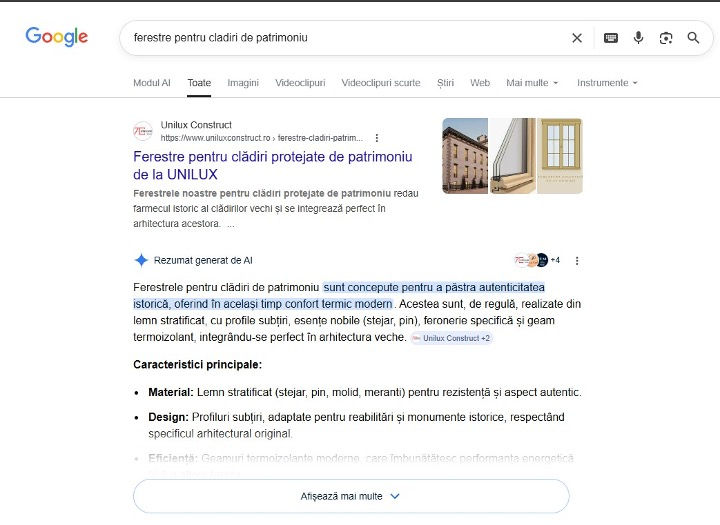
First results observed in Google AI Overview (March 2026), approximately 45 days after the development of the information ecosystem for Unilux Heritage began.
These initial results did not yet demonstrate a consistent presence, nor did they indicate a high level of visibility.
Instead, they confirmed something far more important:
the published information was beginning to be considered sufficiently relevant to be selected by an AI system.
This represents a fundamental difference compared to traditional SEO optimization.
A website can be indexed by search engines without its information subsequently being used in responses generated by artificial intelligence.
In the case of Unilux Heritage, the first appearances in Google AI Overview demonstrated that the system had already begun to regard the published content as a relevant source for certain questions asked by users.
These results marked the starting point for the next stage of the project.
In the months that followed, work continued on:
• developing the information ecosystem;
• strengthening the website architecture;
• expanding contextual interlinking;
• publishing additional materials dedicated to built heritage;
• strengthening Digital Authority through educational and well-documented content.
The objective was not to improve a single SEO / GEO metric, but to develop a coherent information ecosystem capable of answering as many real user questions as possible.
Several months later, these efforts were evaluated through an independent verification conducted simultaneously across three different AI systems:
• ChatGPT;
• Gemini;
• Perplexity.
Unlike Google AI Overview, this stage made it possible to analyze a large number of different questions and observe how each system selects the sources used to generate its responses.
The results presented in the following chapters document this evolution.
The purpose of this study is not to demonstrate an isolated appearance in a single AI-generated response.
Its objective is to evaluate the consistency with which content published by Unilux Heritage is selected when users ask different questions about the restoration of windows for heritage buildings.
This approach provides a far more meaningful assessment of Digital Authority than simply verifying a single search query.
Based on these observations, an official verification was conducted using three independently developed AI platforms, each with its own source selection mechanisms and response generation models.
The methodology used for this verification is presented in the following chapter.
The first documented appearances in Google AI Overview are presented in detail in the case study dedicated to this topic:
Google AI Overview – Mirio Development Case Study
To better understand how these results contribute to the development of Digital Authority, readers may also consult the following case study:
4. Verification Methodology
After the first results were observed in Google AI Overview, the next step was to evaluate how the information published by Unilux Heritage is utilized by the leading publicly available AI systems.
The objective of the verification was not to obtain a favorable response from a single platform.
Instead, the analysis aimed to identify consistent patterns in the way content is utilized across independently developed AI systems, each using its own source selection models and response generation mechanisms.
For this reason, three different platforms were selected:
-
ChatGPT;
-
Gemini;
-
Perplexity.
These systems do not operate in the same way.
Each uses different information sources, different information evaluation models and proprietary algorithms to generate responses.
For this reason, obtaining similar results across all three platforms represents a far more meaningful indicator than verifying a single AI application.
Questions Used
The analysis was conducted exclusively using non-branded queries.
None of the verifications included the following names:
-
Unilux;
-
Unilux Heritage;
-
Unilux Construct.
This is important because users do not always search for a company by its name.
Most of the time, they are looking for a solution to a specific problem.
For this reason, all of the questions used were formulated exactly as they might be asked by someone interested in the restoration of built heritage.
These included:
-
Who restores windows for listed heritage buildings?
-
Which companies have experience in restoring heritage windows?
-
How do I choose a company specializing in the restoration of historic wood windows?
-
Restoration or replacement for historic windows?
-
How are historic wooden windows restored?
-
Who has experience in restoring historic windows?
-
How is the original woodwork of a historic building preserved?
-
Which specialists work in the restoration of built heritage?
-
How are original windows restored?
-
Which companies restore historic wood windows?
-
How do I choose heritage restoration specialists?
-
Who carries out restoration work on historic buildings?
-
What is the difference between restoration and replacement?
-
How are original windows preserved?
-
Who can restore the woodwork of a listed heritage building?
-
Which companies specialize in heritage restoration?
-
How are old wooden windows restored?
-
Who restores historic wood windows?
These questions cover the most important topics developed within the Unilux Heritage information ecosystem.
What Was Evaluated
Each response generated by the AI systems was analyzed from four perspectives.
1. Content Utilization
Cases were identified in which AI systems utilized information similar to that developed in the content published on the Unilux Heritage website.
2. Company Mentions
The analysis verified whether Unilux Heritage was explicitly mentioned in the responses generated for the questions included in the study.
3. Association with the Area of Expertise
The analysis examined whether AI systems associated the company with topics such as:
built heritage restoration;
historic window restoration;
original woodwork;
heritage conservation;
listed heritage buildings.
4. Company Recommendation
The analysis verified whether AI systems included the company among the organizations recommended to users seeking specialists in built heritage restoration.
This represents the highest level of relevance evaluated in the analysis.
Parametrii verificarii
Parameter
Company Analyzed
Industry
Information Ecosystem Development Period
Verification Date
Question Type
Number of Questions Analyzed
AI Platforms Analyzed
Value
Unilux Heritage
Built Heritage Restoration
February – June 2026
June 2026
Exclusively Non-Branded
18
ChatGPT, Gemini, Perplexity
How the Verifications Were Conducted
The verifications presented in this study were conducted using a professional platform specialized in AI Visibility monitoring, developed to evaluate how organizations are utilized, mentioned or recommended by modern AI systems.
The platform automates the verification process, applies a standardized analysis methodology and enables the comparison of results obtained across different AI systems, reducing the influence of variables that may occur during manual testing.
This does not mean that such verifications cannot also be performed manually.
On the contrary, to validate specific results or conduct targeted research, direct testing across different LLM systems is also recommended, using verification conditions that are as close as possible to those of a neutral user.
In practice, this may include using different web browsers, private (Incognito) browsing windows, sessions without logging into user accounts, disabling location services and, where necessary, using a VPN to minimize the influence of geographic factors or personal usage history.
The same questions can then be submitted individually to platforms such as Google AI Overview, ChatGPT, Gemini, Perplexity, Claude, Microsoft Copilot, DeepSeek, Grok, Llama, Mistral, Qwen, Phi or other relevant LLM systems, with the responses compared based on the sources used, the organizations mentioned and the way a company's expertise is presented.
The results presented in this study reflect the situation observed at the time the analysis was conducted and should be interpreted in the context of the continuous evolution of AI models, the information sources they rely on and the ongoing updates to these systems.
Overall Results
Before analyzing each AI system in detail, the overall results can be summarized as follows.
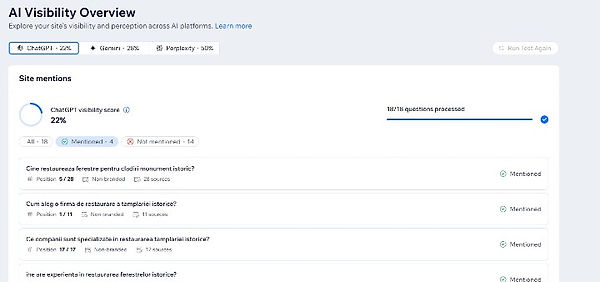
Overall results obtained in ChatGPT, Gemini and Perplexity following the analysis of 18 non-branded questions.
The results obtained were as follows:
System
ChatGPT
Gemini
Perplexity
AI Visibility
22%
28%
56%
These percentages do not represent an assessment of the company's quality, nor do they guarantee commercial results.
They indicate solely the frequency with which the company is utilized, mentioned or associated with the topics covered by the set of questions used in the analysis.
These results should be interpreted within the context of the methodology.
All of the questions used were non-branded, meaning the AI systems had to independently identify the sources they considered relevant for each topic.
The fact that the same non-branded questions produced different results across platforms can also be examined through query fan-out, because each system may reformulate the question, retrieve different source types and construct the answer differently.
Therefore, the mere appearance of the company in the generated responses already indicates that the information developed over the past few months is beginning to be utilized by AI systems.
The analysis presented so far provides the overall picture.
The following chapters examine each of the three platforms individually to observe:
-
what types of questions generate mentions;
-
which sources are utilized;
-
how the company is described;
-
the context in which Unilux Heritage appears;
-
the differences between ChatGPT, Gemini and Perplexity.
5. Results Obtained in ChatGPT
ChatGPT was the first system analyzed as part of the comparative verification.
The overall AI Visibility score obtained was 22%.
At first glance, this percentage may appear modest compared to the results later obtained in Gemini and Perplexity.
However, these results must be interpreted within the context of the methodology used.
The verification did not use any branded searches.
None of the questions submitted included the following names:
-
Unilux;
-
Unilux Heritage;
-
Unilux Construct.
As a result, ChatGPT had to independently identify the sources it considered relevant to built heritage restoration.
This is precisely why the mere appearance of the company already represents an important result.
Who Restores Windows for Listed Heritage Buildings?
The first verification focused on one of the most common questions asked by people interested in the restoration of built heritage.

ChatGPT answers the question "Who Restores Windows for Listed Heritage Buildings?" using information consistent with the expertise developed by Unilux Heritage.
By analyzing the response, we can see that the system does not provide a generic answer.
Instead, its explanation is built around criteria specific to built heritage:
-
preservation of original elements;
-
restoration experience;
-
respect for historical value;
-
interventions on listed heritage buildings.
These themes are consistent with the content developed as part of the Unilux Heritage information project.
More importantly, the user is not searching for the company.
They are looking for a solution to a specific problem.
This is exactly the type of search for which the information ecosystem was designed.
How Do I Choose a Company Specializing in the Restoration of Historic Wood Windows?
The second verification focused on the decision-making process of a potential client.
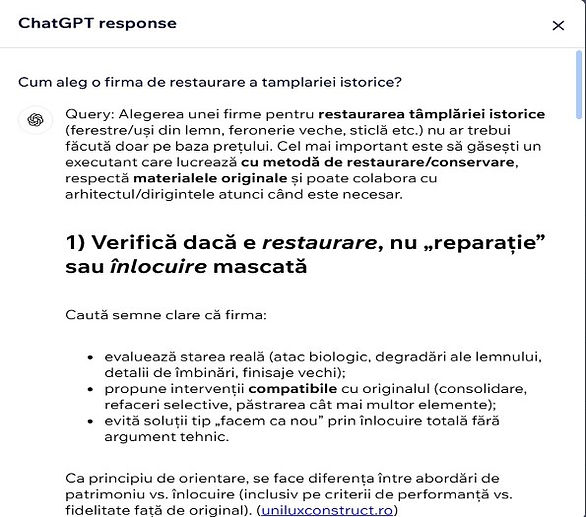
ChatGPT answers the question "How Do I Choose a Company Specializing in the Restoration of Historic Wood Windows?"
The response generated by ChatGPT emphasizes criteria such as:
-
documented experience;
-
portfolio;
-
specialization;
-
heritage conservation capabilities;
-
previously completed similar projects.
These criteria are consistent with the way Unilux Heritage presents its expertise throughout the published content.
Once again, we can observe that the system does not rely on general definitions, but instead generates a response focused on the actual decision-making process.
How Are ChatGPT Responses Generated?
An important aspect of the verification is the analysis of the sources utilized.
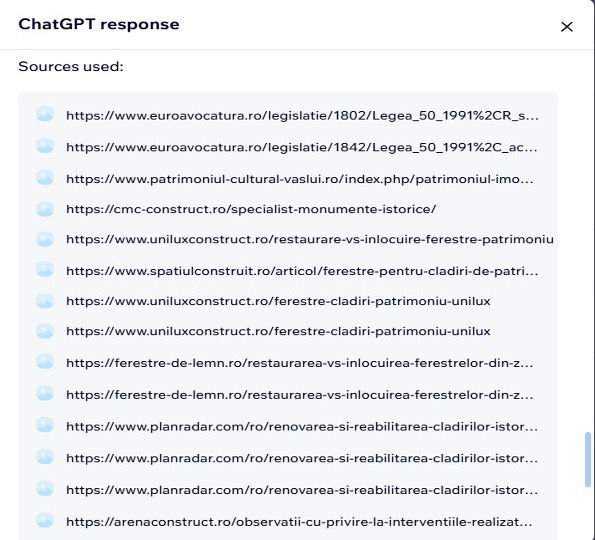
Examples of sources utilized by ChatGPT to generate responses related to built heritage restoration.
The analysis of these sources shows that the responses are not generated randomly.
ChatGPT utilizes information from sources it considers sufficiently relevant to explain the subject.
This is why developing well-documented content is so important.
A website alone is not enough.
The information must answer real questions and provide sufficient detail to be utilized by AI systems.
What Do We Observe in ChatGPT?
The analysis of the 18 questions shows that ChatGPT utilizes information associated with the following topics:
• built heritage restoration;
• historic window restoration;
• restoration of original woodwork;
• preservation of historic elements;
• listed heritage buildings.
These results do not constitute explicit commercial recommendations.
They do not guarantee projects, nor do they automatically indicate the generation of business inquiries.
They do, however, document a verifiable fact: the content developed for Unilux Heritage is beginning to be utilized by ChatGPT when users ask relevant questions about built heritage restoration.
This represents the first level of informational relevance observed in the study.
While ChatGPT demonstrates the utilization of the published content, the next chapter presents an additional level of association.
The Gemini analysis shows that the system not only utilizes the information developed for the company, but also begins to explicitly associate Unilux Heritage with leading specialists in the field of built heritage restoration.
6. Results Obtained in Gemini
The second system analyzed was Gemini, Google's AI platform.
The verification was conducted using the same set of 18 non-branded questions previously used in ChatGPT.
The overall result was an AI Visibility Score of 28%, higher than the score observed in ChatGPT.
The difference lies not only in the percentage achieved.
An analysis of the generated responses reveals a significant change in behavior.
While ChatGPT frequently utilizes information associated with the field, Gemini begins to explicitly identify specialized companies and associate them with the expertise required for built heritage restoration.
This represents an additional level of informational relevance.
Who Has Experience in the Restoration of Historic Windows?
The first question analyzed focused on identifying specialists in the restoration of historic windows.
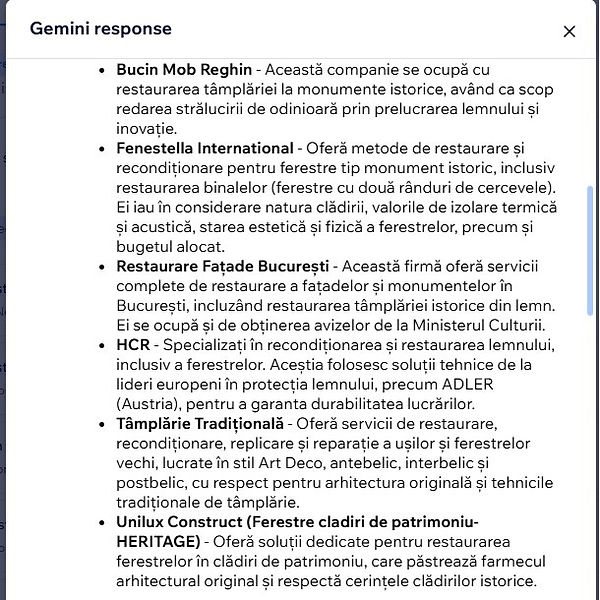
Gemini answers the question "Who Has Experience in the Restoration of Historic Windows?" by presenting Unilux Heritage among the companies relevant to this field.
The response is not limited to general explanations about built heritage.
Gemini identifies specialized companies and associates them with the restoration of historic wood windows.
This is important because the user is not asking for information about Unilux Heritage.
The question is formulated in a generic way.
The AI system independently selects the organizations it considers relevant to the topic being analyzed.
Which Companies Have Experience in the Restoration of Heritage Windows?
A second question, phrased differently but with the same objective, was used to confirm the results.

Gemini answers the question "Which Companies Have Experience in the Restoration of Heritage Windows?" by associating Unilux Heritage with the field of built heritage restoration.
The result confirms the previous observation.
Although the question is phrased differently, the system continues to associate the company with the same area of expertise.
This level of consistency is far more meaningful than obtaining a favorable response to a single question.
It suggests that the association between the company and the field of built heritage restoration is beginning to become established.
Sources Utilized by Gemini
In addition to the generated responses, the sources utilized by the system were also analyzed.

Examples of sources utilized by Gemini to generate responses related to built heritage restoration.
The analysis shows that Gemini generates its responses by utilizing information from multiple relevant sources.
This is important because it confirms that the responses are neither generated randomly nor based on a single web page.
Instead, the system correlates information from multiple sources to generate coherent and well-documented responses.
From the perspective of Digital Authority development, this highlights the importance of building an information ecosystem, not just a well-optimized website.
What Do We Observe in Gemini?
What Do We Observe in Gemini?
Compared to ChatGPT, Gemini demonstrates a noticeable change in behavior.
In addition to utilizing the published content, the system begins to explicitly associate the company with the field of built heritage restoration.
This association is observed across multiple variations of the same question, suggesting that it is not an isolated response.
The topics with which the company is consistently associated include:
• historic window restoration;
• heritage woodwork;
• listed heritage buildings;
• preservation of original elements;
• restoration specialists.
These results confirm that the information ecosystem developed since February 2026 is beginning to be interpreted by Gemini as representative of the company's area of expertise.
The AI Visibility Score of 28% achieved in Gemini represents an improvement over the results observed in ChatGPT.
However, the most interesting stage of the verification emerges in the Perplexity analysis.
There, we no longer observe only the utilization of content or the association of the company with its area of expertise.
In certain responses, Perplexity explicitly includes Unilux Heritage among the companies recommended for built heritage restoration, while also achieving the highest AI Visibility Score in this study: 56%.
7. Results Obtained in Perplexity
The last platform analyzed in the study was Perplexity.
Among the three systems evaluated, it achieved the highest result, with an AI Visibility Score of 56%.
The difference compared to ChatGPT and Gemini is not limited to the percentage itself.
The analysis of the responses shows that Perplexity more frequently utilizes the available sources, explicitly cites the pages it consults and, in certain situations, directly recommends companies it considers relevant to the question being asked.
This behavior makes Perplexity a particularly valuable platform for evaluating how a company is perceived and utilized by AI systems.
Overall Verification Results
Before analyzing the individual responses, it is useful to examine the overall result obtained during the verification.
AI Visibility Overview in Perplexity. The overall result achieved by Unilux Heritage following the verification of 18 non-branded questions.
The score of 56% represents the highest value achieved among the three AI platforms analyzed.
This result does not mean that the system recommends the company for every question.
It does, however, show that for a significant number of the questions submitted, Perplexity utilizes or mentions information associated with Unilux Heritage.
Who Restores Windows for Listed Heritage Buildings?
The first verification confirms that Perplexity identifies Unilux Heritage as a relevant source for this field.

Perplexity answers the question "Who Restores Windows for Listed Heritage Buildings?" by utilizing information associated with Unilux Heritage.
Compared to the systems analyzed previously, the response is more comprehensive and includes direct references to the sources utilized.
This allows users to quickly verify the information presented while providing an additional level of transparency.
Which Companies Have Experience in Built Heritage Restoration?
The second verification confirms the consistency of the results.

Perplexity identifies Unilux Heritage among the companies relevant to built heritage restoration.
We can observe that the response is not based exclusively on theoretical definitions.
The system identifies organizations active in the field and associates them with the expertise required to carry out restoration work.
This represents one of the most important findings of the study.
The user is not searching for the company by name.
They are looking for a specialist.
Perplexity independently identifies the company as being relevant within that context.
Restoration or Replacement?
One of the topics developed within the Unilux Heritage information ecosystem is the comparison between the restoration and replacement of historic windows.
This topic was evaluated separately.

Perplexity utilizes information related to the comparison between the restoration and replacement of historic windows.
The response generated is based on both technical and heritage-related arguments.
It examines the advantages of preserving the original woodwork, the historical value of the existing elements and the situations in which restoration represents the recommended solution.
These topics are consistently reflected in the information content developed for Unilux Heritage.
An important advantage of Perplexity is its transparency regarding the sources it utilizes.
The analysis of these screenshots shows that the responses are generated based on a large number of sources.
Perplexity allows these sources to be verified, making it easier to understand how the system arrives at the conclusions it presents.
From the perspective of Digital Authority, this is particularly important.
A single well-optimized page is not enough.
The platform tends to favor consistent information ecosystems composed of multiple relevant pieces of content that are well connected through contextual interlinking.

What Do We Observe in Perplexity?
What Do We Observe in Perplexity?
The analysis of the responses obtained highlights several consistent patterns.
The company is associated with:
• built heritage restoration;
• historic window restoration;
• preservation of original woodwork;
• listed heritage buildings;
• restoration specialists.
Compared to ChatGPT and Gemini, Perplexity demonstrates the highest frequency of utilizing content associated with Unilux Heritage.
At the same time, the platform provides the highest level of transparency regarding the sources it utilizes and allows them to be verified quickly.
Within the context of this study, the AI Visibility Score of 56% represents the strongest indicator of how the information ecosystem developed since February 2026 is being utilized by an AI system to generate responses for users.
When analyzed individually, ChatGPT, Gemini and Perplexity exhibit significant differences in the way they operate.
Viewed together, however, they provide a far more meaningful perspective on how artificial intelligence interprets and utilizes the information published about Unilux Heritage.
The following chapter compares these results to identify the common patterns and the conclusions that can be drawn from the study as a whole.
8. Interpretation of the Results
The results obtained in ChatGPT, Gemini and Perplexity should not be analyzed in isolation.
The real value of this case study lies in observing the behavior of all three AI systems as a whole.
Each platform utilizes different information processing models, different sources and its own mechanisms for generating responses.
For this reason, it was not expected that all responses would be identical.
Nevertheless, the analysis highlights one important finding:
all three systems arrive at the same fundamental association between Unilux Heritage and built heritage restoration.
This consistency represents one of the most important findings documented in this study.
Observed Progression
The project timeline makes it possible to understand how the results evolved.
Period
Februarie 2026
Martie - Aprilie 2026
Iunie 2026
Iunie 2026
Iunie 2026
Event
Beginning of the Unilux Heritage Information Ecosystem Development
First Results Observed in Google AI Overview
ChatGPT Verification – AI Visibility 22%
Gemini Verification – AI Visibility 28%
Perplexity Verification – AI Visibility 56%
This sequence is important because it shows that the results did not appear instantly.
First, the information ecosystem was developed.
Next, the first signals appeared in Google AI Overview.
Only after approximately four months was the official verification conducted across the three AI systems.
This suggests that the development of Information Authority is a gradual process that requires time before producing observable results.
What Do the Three Platforms Have in Common?
Although they utilize different technologies, ChatGPT, Gemini and Perplexity share several common characteristics.
All three systems:
• utilize information related to built heritage restoration;
• associate Unilux Heritage with the restoration of historic windows;
• identify the company's expertise in heritage woodwork;
• generate responses using information relevant to the questions being asked.
These observations are important because they confirm that the association is not the result of a single platform.
Instead, it appears independently across three AI systems developed separately.
Where Do the Differences Appear?
Although the overall conclusion is similar, each platform exhibits different behavior.
Platform
ChatGPT
Gemini
Perplexity
Observed Behavior
• Utilizes relevant information and provides accurate responses to questions related to built heritage.
• Explicitly associates the company with leading specialists in the field of built heritage restoration.
• Frequently utilizes available sources, explicitly cites the pages consulted and recommends the company for specific queries.
What This Study Does Not Demonstrate
The results should be interpreted with caution.
This study does not demonstrate:
• increased sales;
• an increase in the number of clients;
• increased website traffic;
• guaranteed inclusion in all AI-generated responses;
• the automatic generation of commercial projects.
These outcomes depend on numerous other variables that are beyond the scope of this study.
An Important Observation
Perhaps the most valuable conclusion of this study is not represented by the percentages obtained.
The scores of 22%, 28% and 56% are simply summary indicators of the verifications conducted.
More important is the fact that all three platforms converge on the same conclusion.
When users ask questions about:
• built heritage restoration;
• historic window restoration;
• heritage woodwork;
• listed heritage buildings;
the AI systems consistently identify Unilux Heritage as being relevant to these topics.
This level of consistency is difficult to achieve by chance.
It suggests that the information ecosystem developed since February 2026 is beginning to be interpreted by artificial intelligence as a credible source within the field of built heritage restoration.
The results presented in this chapter provide the foundation for the final conclusions of the study.
The final chapter summarizes the key findings and explains the significance of these results for companies seeking to develop Digital Authority and increase their visibility across AI systems.
9. Conclusions
The project presented in this case study began in February 2026 with the objective of developing an information ecosystem dedicated to built heritage restoration.
The first verifiable results were observed approximately one month later, in March 2026, with the appearance of content associated with Unilux Heritage in Google AI Overview.
Subsequently, after approximately four months of continuous development of content, Digital Authority and the information architecture, an independent verification was conducted using three of the world's leading publicly available AI systems:
ChatGPT;
Gemini;
Perplexity.
The analysis was based on 18 non-branded questions formulated to reflect the way users actually search for information about built heritage restoration.
The results demonstrated that the information developed for Unilux Heritage is utilized differently by each AI system, yet all three lead to the same fundamental conclusion.
Project Progression
Period
Pentru coloana Period, traducerile sunt:
February 2026
March – April 2026
June 2026
June 2026
June 2026
Documented Result
Beginning of the Information Ecosystem Development
First Results Observed in Google AI Overview
ChatGPT – AI Visibility 22%
Gemini – AI Visibility 28%
Perplexity – AI Visibility 56%
This timeline is important because it demonstrates that the results did not appear instantly.
First, the content was developed.
Next, the first signals appeared in Google AI Overview.
Only after several months was it possible to verify the consistency of the results across multiple independently developed AI systems.
What Does This Study Demonstrate?
The analysis conducted does not seek to demonstrate a ranking position or the achievement of commercial results.
Instead, the study documents a different aspect.
More specifically, it examines how artificial intelligence utilizes, interprets and associates the information published about a company specializing in built heritage restoration.
The results obtained support the following observations.
1. Published Content Is Utilized by AI Systems
ChatGPT utilizes information developed within the information ecosystem when answering questions related to built heritage restoration.
2. The Company Is Associated with Its Area of Expertise
Gemini identifies Unilux Heritage as being relevant to topics such as:
• historic window restoration;
• built heritage;
• historic woodwork;
• listed heritage buildings.
3. The Company Is Recommended for Specific Queries
Perplexity explicitly includes Unilux Heritage among the companies it considers relevant for certain user queries.
This represents the highest level of relevance observed in the study.
4. The Results Are Consistent
Perhaps the most important conclusion is not represented by the scores achieved.
More important is the fact that all three AI systems arrive at the same association.
When users search for information about:
• built heritage restoration;
• historic window restoration;
• preservation of original woodwork;
• listed heritage buildings;
ChatGPT, Gemini and Perplexity consistently identify Unilux Heritage as being relevant to these topics.
This consistency represents the strongest finding documented in this study.
What This Study Does Not Demonstrate
For the purpose of avoiding misinterpretation, it is important to clarify what this analysis does not demonstrate.
This study does not guarantee:
• increased sales;
• an increase in the number of clients;
• increased website traffic;
• the company's appearance in all AI-generated responses;
• the company being recommended consistently.
These outcomes depend on numerous other variables and are beyond the scope of this study.
A Change Worth Watching
Until recently, the process of gathering information began almost exclusively with traditional search engines.
Today, an increasing number of users ask their questions directly in ChatGPT, Gemini or Perplexity.
In this context, the way a company is described and utilized by AI systems is becoming an increasingly important aspect of its digital presence.
The results presented in this study suggest that developing a coherent information ecosystem can influence the way these systems identify and utilize a company's expertise.
Study Conclusion
Study Conclusion
After approximately four months of developing the information ecosystem:
• Google AI Overview utilizes content associated with Unilux Heritage;
• ChatGPT utilizes information developed as part of the project;
• Gemini associates the company with leading specialists in the field of built heritage restoration;
• Perplexity recommends the company for certain queries and achieves the highest AI Visibility Score among the platforms analyzed.
These results do not represent a guarantee of future commercial performance.
They do, however, document a verifiable fact:
The expertise developed and documented for Unilux Heritage is beginning to be utilized by different AI systems when users search for information about built heritage restoration.
This is the principal outcome of the project presented in this case study.
Relevant Case Studies
If you would like to explore in greater depth how content can influence Digital Authority and visibility across AI systems, you may also consult the following case studies developed by Mirio Development.
SEO, Digital Authority and AI Trust – Unilux
https://www.miriodev.ro/en/unilux-seo-digital-authority-ai-trust-case-study
A comprehensive analysis of the information strategy developed for Unilux Heritage and the information ecosystem that formed the foundation for the results presented in this study.
Google AI Overview – Mirio Development Case Study
https://www.miriodev.ro/en/miriodev-google-ai-overview-case-study
Documentation of the first results achieved in Google AI Overview and an analysis of how published content begins to be utilized by AI systems.
Build a Digital Ecosystem Ready for AI Systems
Build a Digital Ecosystem Ready for AI Systems
The results presented in this study did not happen by chance.
They are the outcome of developing a digital ecosystem built around expert content, Digital Authority, information architecture, interlinking, editorial validation and the documentation of the company's expertise.
Mirio Development develops these types of projects for companies seeking to strengthen their digital presence and increase the likelihood that their published information will be utilized, cited or recommended by AI systems such as Google AI Overview, ChatGPT, Gemini, Perplexity, Claude, DeepSeek and others.
What level of investment is required to build visibility across AI systems?
Depending on a company's objectives, industry, competitive landscape, target markets and desired pace of growth, the investment required for a strategic digital plan focused on SEO, GEO, Digital Authority and AI Trust can vary significantly.
In practice, projects developed by Mirio Development typically start at approximately EUR 600 per month for local or regional companies and can exceed EUR 100,000 per year for international organizations pursuing simultaneous expansion across multiple markets, the development of a complex editorial ecosystem, international validation and the strengthening of their presence across AI systems on a global scale.
The level of investment is influenced by numerous factors, including:
• technical complexity;
• the number of products or services promoted;
• the number of target languages and markets;
• the existing level of competition;
• the brand's history and market recognition;
• the scale of the digital ecosystem to be developed;
• the implementation timeline;
• medium- and long-term business objectives.
For example, for one of the international projects developed by Mirio Development for a company operating in the United Kingdom and multiple international markets, the estimated investment for implementing the Digital Authority and AI Trust strategy ranges from approximately EUR 32,500 to EUR 110,000 per year, depending on the implementation scenario selected, the complexity of the digital editorial ecosystem and the scope of the validation required for each target country.
If you would like to discuss the development of a digital ecosystem tailored to your company, you can contact us here: https://www.miriodev.ro/en/contact-mirio
An Important Observation
An Important Observation
This case study does not represent a guarantee that similar results can be achieved for every company.
It documents a real project developed over several months, based on a coherent strategy focused on content, Digital Authority, GEO and AI Trust.
The results obtained depend on numerous variables, including the industry, the level of competition, content quality, the company's history and the consistency with which the strategy is implemented.
Why Do We Consider This Study Highly Relevant?
Why Do We Consider This Study Highly Relevant?
This is not simply another case study about Unilux Heritage.
It is one of the first and few documented case studies in Romania to analyze how the same company is utilized and interpreted simultaneously by:
• Google AI Overview;
• ChatGPT;
• Gemini;
• Perplexity.
The analysis is based on a documented set of non-branded questions, screenshots, an explicit methodology and measurable results, providing a practical perspective on how the development of a coherent digital ecosystem can influence a company's presence in responses generated by artificial intelligence.
Methodological Note
The AI Visibility scores presented in this study were obtained using a professional AI monitoring and analytics platform designed to evaluate companies' presence across LLM-based AI systems.