


How to Be Cited by AI
A Complete Guide to Digital Authority, SEO, GEO and AI Trust
Why Some Companies Become Sources for Google and AI Systems, While Others Remain Simple Websites

CUPRINS
1. INTRODUCTION – THE NEW DIGITAL REALITY
In recent years, almost every company has understood that it needs an online presence.
Websites, service pages, product catalogues, a few blog articles, basic SEO and, in many cases, Google Ads have become standard elements of digital presence.
For a period of time, this model worked. Companies built websites, optimised a few pages, published articles, invested in advertising and waited for traffic.
Today, however, the way clients search, compare and choose suppliers has changed profoundly.
We are no longer talking only about Google in its traditional form.
An increasing number of users now seek answers directly from systems such as ChatGPT, Google Gemini, Microsoft Copilot, Perplexity and Claude.
At the same time, Google is increasingly introducing AI-generated responses and synthetic summaries into search results through AI Overviews.
These systems do not function as simple business directories.
They do not merely display links.
They summarise, compare, prioritise, interpret and select sources.
In many cases, users no longer browse ten different websites to form an opinion. Instead, they read a summary, recommendation or explanation provided by an AI system.
AI citation is influenced by the quality, consistency, and credibility of the information available about a company. To understand the broader strategy behind this process, explore our Complete Guide to Build Digital Authority and AI Visibility.
Here is the new challenge facing companies:
It is no longer enough simply to be online.
A company must be sufficiently clear, coherent and credible to be understood, selected and, in certain cases, cited by AI systems.
In the new digital reality, the difference is no longer simply between companies that have a website and those that do not.
The distinction becomes far more subtle — and far more important:
-
companies that exist online;
-
companies that are found;
-
companies that are understood;
-
companies that are considered relevant;
-
companies that can become trusted sources.
These levels are not the same.
-
A website can exist without being relevant.
-
A website can be indexed without being understood.
-
A website can generate traffic without generating trust.
-
A brand may be detectable, but not necessarily citable.
This is the major shift that many companies still do not fully understand.
2. THE PROBLEM IS NOT AI.
THE PROBLEM IS DIGITAL TRUST
Many companies believe that AI can be addressed in a simple way:
-
“we create articles with ChatGPT”;
-
“we publish more content”;
-
“we add a few keywords”;
-
“we optimise for AI”;
-
“we write more blog content”.
The reality is far more complex.
AI does not automatically transform a weak website into a credible source.
-
It does not fix a lack of clarity.
-
It does not compensate for a lack of reputation.
-
It does not replace strategy.
-
It does not turn generic content into genuine expertise.
On the contrary, AI systems tend to expose exactly the problems that many companies have ignored for years:
-
commercial pages that are too short;
-
generic content;
-
lack of real explanations;
-
fragmented technical information;
-
lack of external trust signals;
-
websites that present, but do not explain;
-
vaguely described services;
-
products listed without selection criteria;
-
articles published without direction;
-
blogs that exist only for volume;
-
lack of a clear informational architecture.
This is where the difference between online presence and digital authority begins to emerge.
Online Presence
The company exists online
Functional website
Product or service pages
Traffic
Advertising
Published content
Active blog


Digital Authority
The company is perceived as a relevant source
Coherent informational system
Content that supports selection
Trust and selection
Validation and positioning
Content that explains and differentiates
Editorial architecture with a strategic role
Online presence is only the first level.
Digital authority emerges when information is organised in such a way that users, Google and AI systems can understand:
-
who you are;
-
what you do;
-
which field you have expertise in;
-
what problems you solve;
-
how your products or services should be selected correctly;
-
what differences exist between solutions;
-
why you should be considered.
This is not achieved through publishing alone. It is achieved through clarity, coherence and validation.
3. WHAT WE OBSERVED AFTER DEVELOPING 94 STRATEGIC PLANS
Between October 2025 and May 2026, we developed 94 strategic Digital Authority and AI Trust plans.
This means 94 websites analysed from structural, technical and strategic perspectives, including:
-
on-page SEO;
-
informational structure;
-
external authority;
-
existing content;
-
editorial coherence;
-
indexation;
-
trust signals;
-
selection capability within Google and AI systems;
-
growth potential through decision-oriented content.
The analysed projects did not come from a single industry.
We assessed websites belonging to product suppliers, service providers, B2B companies, online stores, premium services, international projects, local platforms, industrial companies, construction-related businesses, airport services, religious tourism projects and large e-commerce platforms.
The conclusion was very clear:
In approximately 90% of cases, the analysed websites had significant issues affecting their ability to become relevant sources for Google, users and AI systems.
-
Some websites had technical problems.
-
Others had very weak external authority.
-
Others had insufficient content.
-
Others generated traffic but lacked structure.
-
Others offered good products or good services but failed to explain clearly enough why they should be chosen.
Observed Issues
Insufficient content
Weak external authority
Technical SEO issues
Lack of decision-oriented content
Overly commercial pages
Lack of external validation
Traffic without structure
Generic content
Blog without strategy


Impact on SEO and AI Trust
-
The website does not fully answer users' questions
-
Google and AI systems have limited trust signals
-
Site indexation and understanding are affected
-
Users are not guided towards selection
-
The content sells, but does not explain
-
The brand remains digitally isolated
-
Visibility does not translate into selection
-
The website does not differentiate itself as a source
-
Articles remain isolated and fail to strengthen authority
Very importantly, most companies did not have problems because their products or services were weak.
The real problem was different:
The company’s expertise was not sufficiently explained, organised or digitally validated.
This conclusion is essential.
Many companies possess genuine expertise, good products, reliable services and real market experience.
But that expertise often remains trapped inside the company — in commercial discussions, proposals, emails, catalogues, documentation or the experience of the team itself.
If expertise is not transformed into clear, coherent and accessible content.
4. THE PROBLEM AFFECTS BOTH PRODUCT SUPPLIERS AND SERVICE PROVIDERS
This shift does not affect only manufacturers or suppliers of technical products.
In the analyses conducted, the same patterns appeared across:
• product suppliers;
• service providers;
• B2B companies;
• B2C companies;
• premium services;
• e-commerce businesses;
• international projects;
• local platforms;
• tourism services;
• operational services;
• construction-related companies;
• industrial companies;
• VIP airport services;
• pilgrimage projects;
• large online stores.
Among product suppliers, the problem frequently appears when the website functions merely as a catalogue: products, categories, specifications, pricing and documentation, but without clear explanations regarding selection, differences, use cases, limitations or real-world scenarios.
A manufacturer may have hundreds of products, technical datasheets and detailed catalogues.
But if it does not explain how a solution should be selected correctly, the user is left alone with the information.
AI may understand that the company sells products, but it may consider another source more suitable for explaining the decision.
Among service providers, the problem appears differently.
The website presents the services but does not sufficiently explain the process, selection criteria, risks, differences compared to alternatives, situations in which the service is appropriate or the realistic outcome a client may expect.
Company Type
Product supplier
Service provider
E-commerce
Technical B2B
B2C
Premium services
International project


Common Problem
Catalogue and specifications
General descriptions
Large number of products and URLs
Extensive documentation
Promotional content
Clear offer, but superficial
Dispersed authority
What Is Missing
Explanation of the selection process
Process clarification
Pages that explain the decision
Context and interpretation
Trust and comparisons
Real-world scenarios and criteria
Coherence across domains, languages and sources

In the AI era, a company must do more than simply be found.
It must be understood.
And this applies regardless of whether the company sells products, services, technical solutions, consultancy, experiences, subscriptions or customised products.
5. A LARGE WEBSITE DOES NOT AUTOMATICALLY MEAN INFORMATIONAL AUTHORITY
An important example comes from the world of e-commerce and international projects.
There are companies that have:
• thousands or tens of thousands of URLs;
• brand recognition;
• international presence;
• extensive product portfolios;
• traffic;
• multiple markets;
• complex SEO infrastructure.
And yet, from an AI perspective, the problem may remain the same:
The brand is detectable, but not necessarily citable.
AI may understand that a company sells products.
But if the website does not explain clearly enough how the right product should be selected, what differences exist, which risks should be avoided and what the real selection criteria are, the AI system may prefer to cite other sources:
-
blogs, trade publications, comparison platforms, external guides or editorial publications.
In other words:
• a company may be an excellent supplier of products and services;
• yet another source may become the reference point.
This is one of the most important shifts in the new digital economy.
Selling a product does not automatically mean controlling the explanation surrounding that product.
Having traffic does not automatically mean having authority.
Having thousands of pages does not automatically mean having a clear informational structure.
In many large projects, the problem is not a lack of volume.
The problem is the lack of pages that explain the decision.
6. HAVING A MODERN WEBSITE IS NOT ENOUGH
A new, fast and well-presented website provides a strong foundation.
But it is not enough.
Many companies invest heavily in design, animations, visual effects, premium themes, modern platforms and complete redesigns.
All of these can be useful.
A modern website can convey professionalism, relevance and visual trust.
The problem is that users and AI systems do not make decisions based solely on visual appearance.
A website may look impeccable and yet:
• explain very little;
• provide superficial answers;
• fail to clarify the differences between solutions;
• fail to help users make a choice;
• fail to build sufficient informational trust.
This is one of the biggest misconceptions in the market.
Many websites are visually impressive, yet fail to function as genuine informational sources.
01.
Element
-
Modern design
-
Animations and visual effects
-
New website
-
Premium platform
-
Strong technical score
-
Coherent informational structure
-
Decision-oriented content
-
External validation
-
Clear explanations
02.
Can It Create a Positive Impression?
-
Yes
-
Yes
-
Yes
-
Yes
-
Yes
-
Yes
-
Yes
-
Yes
-
Yes
03.
Does It Guarantee Authority?
-
No
-
No
-
No
-
No
-
No
-
Yes
-
Yes
-
Yes
-
Yes
Google and AI systems do not evaluate only how a website looks.
What matters is what it explains, how coherently it explains it, how useful it is and how effectively it responds to user intent.
This is why many companies have visually strong websites, yet very weak digital authority.
7. HAVING PRODUCTS, SERVICES, CATALOGUES OR DOCUMENTATION ALONE IS NOT ENOUGH
Especially in technical, industrial, B2B, e-commerce or complex service sectors, many companies already possess valuable information.
But that information does not always answer the client’s real questions and needs:
-
When is this solution right for me?
-
When is it not right for me?
-
What is the difference between two options?
-
What risks exist if I make the wrong choice?
-
What should I verify before requesting a quotation?
-
Which criteria truly matter?
-
How do I compare two options correctly?
-
What should I know before making a decision?
This is where the difference between commercial information and decision-oriented information emerges.
Commercial Content
Presents the product
Describes the service
Emphasises sales
Shows specifications
Talks about the company
Optimises conversion


Decision-Oriented Content
Explains the choice
Clarifies scenarios
Emphasises understanding
Explains differences
Addresses the client’s problem
Optimises selection
In the traditional model, users searched directly for the product or service.
In the AI-influenced model, users increasingly begin with a problem, a comparison, a question, a risk or an uncertainty.
This is why decision-oriented content becomes critical.
8. TRADITIONAL SEO HAS NOT DISAPPEARED. BUT IT IS NO LONGER ENOUGH
SEO remains important.
A website must be indexable, fast, accessible, properly structured, optimised on-page, technically coherent and easy for search engines to interpret.
But traditional SEO no longer covers the entire modern selection process on its own.
In the past, the main question was:
“How do I rank higher in Google?”
Today, the correct question is:
“How do I become a source that is sufficiently relevant and credible for Google, users and AI systems?”
This difference is fundamental.

Traditional SEO
Google rankings
Keywords
Traffic
Technical optimisation
SEO articles
Link building
Volume
Rankings
SEO + GEO + AI Trust
Selection within Google and AI
Intent and context
Trust and selection
Informational infrastructure
Decision-oriented content
External validation
Coherence
Authority

GEO, meaning Generative Engine Optimization, does not replace SEO.
It complements it.
SEO helps a website to be found, indexed and interpreted technically.
GEO and AI Trust help a website to be understood, selected, used as a source and associated with relevant intent.
In other words, SEO remains the foundation.
But in the AI era, the foundation is not enough unless there is also an informational architecture capable of supporting interpretation and selection.
9. RAPIDLY GENERATED CONTENT DOES NOT AUTOMATICALLY BUILD AUTHORITY
Today, many companies believe they can solve the problem through rapidly generated content, dozens of automated articles, accelerated publishing and AI-generated texts created without strategy.
“We publish 50 articles and suddenly we have a blog.”
The problem is that the internet is already full of generic content.
Many texts say the same things, use the same wording, lack real experience, fail to explain sufficiently, do not differentiate and do not help users make decisions.
This type of content may create volume.
But volume is not the same thing as authority.
More concerning, many texts are built artificially through excessive repetition, keyword stuffing, empty wording, structures with little informational value and content lacking genuine experience.
In the AI era, superficial content becomes increasingly easy to ignore.
Modern systems can detect a lack of substance, lack of coherence, lack of clarity and lack of genuine expertise.
Generic Content
Fills the website
Creates volume
Repeats information
Optimises keywords
Creates noise
Appears SEO-driven


Content with Real Value
Builds authority
Creates selection
Explains and clarifies
Optimises understanding
Builds trust
Functions informationally
AI-generated content can be useful as a working tool.
But it cannot replace strategy, expertise, verification, structure or a genuine understanding of the market.
AI can assist with writing.
But it cannot compensate for the absence of strategic direction.
10. WHAT IT REALLY MEANS TO BE CITABLE
Being citable does not mean mentioning AI repeatedly.
It does not mean publishing hundreds of articles.
It does not mean using trendy buzzwords or “optimising for ChatGPT” in a superficial way.
Being citable means that an entire digital presence communicates:
• clarity;
• coherence;
• trust;
• consistency;
• relevance;
• validation;
• experience;
• the ability to explain.
AI systems tend to favour sources that can be interpreted as useful, clear, well-structured, contextually relevant and sufficiently credible.
There is no guaranteed formula through which a company can force ChatGPT, Gemini, Copilot, Perplexity, Claude or Google AI Overviews to cite it.
But there is an enormous difference between a generic, isolated and superficial website and a coherent, validated informational infrastructure.
The first is easy to ignore.
The second has a stronger chance of being understood, selected, recommended and used as a source.
Citability is not an instant result.
It is the cumulative effect of clarity, structure, consistency and validation.
10A. FIRST SIGNALS OBSERVED IN GOOGLE AI OVERVIEWS
In theory, concepts such as Digital Authority, AI Trust, Decision-Support Content, or AI Citability may seem abstract.
That is precisely why practical examples matter.
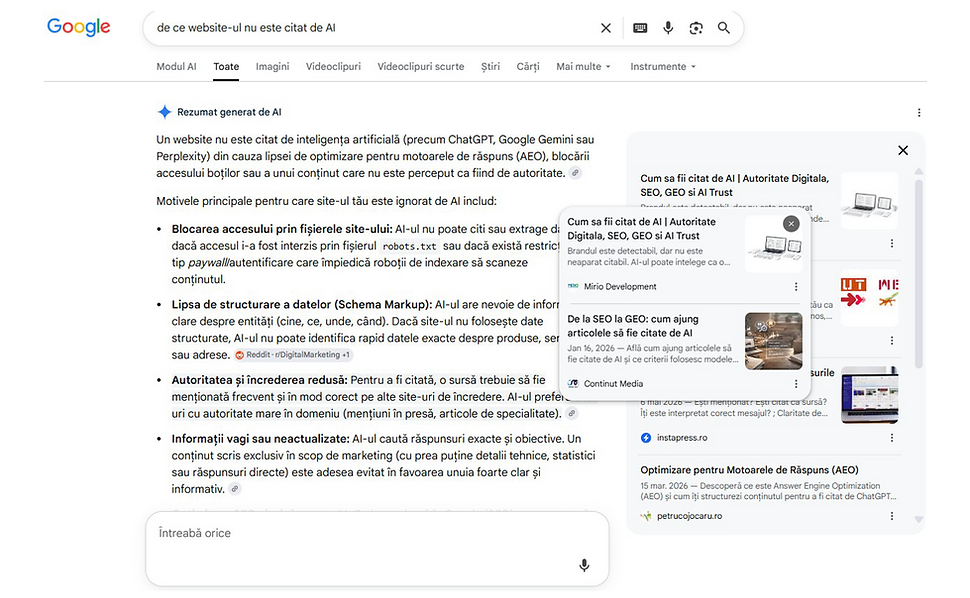
Within the Mirio Development project, the publication of materials focused on Digital Authority, AI Trust, Decision-Support Content, Selection, and AI Citability was followed by the appearance of early observable signals in Google AI Overviews for searches related to these topics.

These observations do not represent guarantees of results, nor do they demonstrate the existence of a universal formula for being cited by AI systems.
They do, however, suggest an important principle:
Websites that publish coherent explanations, decision-support content, case studies, comparisons, and materials capable of answering real user questions may become easier for AI systems to understand, associate with specific topics, and potentially use as sources within emerging AI-driven search experiences.
A more detailed example can be explored in the following case study:
Google AI Overview Case Study – Mirio Development
This example should not be interpreted as a promise of results.
Rather, it illustrates how explanatory content, external validation, and informational coherence may contribute to strengthening a digital theme over time.
11. VISIBILITY WITHOUT STRUCTURE IS NOT ENOUGH
There are companies that already have traffic, sought-after products, genuine services, newsletters, visited pages, brand awareness and active advertising.
But even then, something essential may still be missing: the transformation of visibility into selection.
Traffic alone does not solve the problem.
If users arrive on the website but do not understand which solution suits them, what the real differences are, what risks exist, what should be verified, how to formulate a proper enquiry and why they should choose that supplier, then visibility remains incomplete.
In the AI era, the goal is no longer simply to bring people to the website.
The goal is to build a digital system that helps users understand, compare and choose.
A practical example is the MyHomeIsYours case study, which documents the complete process of analysing, structuring, developing and validating a professional website.

Visibility
Users reach the website
Traffic exists
Visits exist
Impressions exist
Clicks exist
Presence exists
Selection
Users understand
Trust exists
Clarity exists
Relevance exists
Decisions exist
Authority exists

This difference is essential for any company that wants to grow in the years ahead.
Visibility attracts attention.
Selection builds value.
12. A PRACTICAL EXAMPLE: THE UNILUX CONSTRUCT CASE
A relevant example of this shift is the case study developed for Unilux Construct:
SEO, Digital Authority and AI Trust Case Study – Unilux Construct
In this project, the focus was not on producing large volumes of generic content, accelerated publishing or artificially increasing the number of articles.
The emphasis was placed on:
• clarifying information;
• explaining the differences between solutions;
• structuring content for selection;
• strengthening digital coherence;
• reinforcing trust;
• external validation;
• explanatory content;
• informational architecture.
The goal was not to “trick AI”.
The goal was to build a digital presence that is easier to understand, interpret and associate with genuine search intent.
The case study does not demonstrate a guaranteed formula for AI.
But it does confirm a very important direction:
Websites that explain better have a stronger chance of being considered relevant.
13. WHY STRATEGY IS NECESSARY, NOT JUST EXECUTION
Many companies directly request articles, SEO, advertorials, Google Ads, newsletters, AI-generated content or social media posts.
The problem is that without strategy, these actions may remain isolated, disconnected, difficult to sustain, incoherent and lacking a shared direction.
Execution Without Strategy
Disconnected articles
Traffic without direction
Isolated advertising
Generic content
Occasional publishing
Visibility
URLs without purpose


Coherent Strategy
Connected content
Selection pathway
Controlled activation
Decision-oriented content
Continuity
Authority
Informational architecture
-
A single article does not build authority.
-
A single advertorial does not build trust.
-
A Google Ads campaign does not solve a lack of content.
-
A newsletter does not compensate for the absence of strategy.
What matters is what you explain, how you explain it, where you direct users, how you validate externally, how you build trust and how you connect content with the real offer.
This is why many companies publish extensively, invest consistently, yet struggle to grow as genuine authorities.
Execution is necessary.
But execution without architecture risks producing activity rather than progress.
14. AI TRUST IS NOT A BUTTON
One of the most dangerous ideas in the market is the belief that AI Trust can be achieved quickly, automatically, through a plugin, a few settings or automatically generated content.
It does not work that way. AI Trust is not a button!
There is no magic plugin, secret formula or automation that guarantees selection, nor any rapid content capable of building authority overnight.
AI Trust is the result of a coherent digital construction.
It means that company information is:
• clear;
• consistent;
• verifiable;
• well organised;
• supported by useful content;
• externally validated;
• connected to real problems.
The question is not: “How do we trick AI?”
The correct question is:
“How do we build a digital presence that is sufficiently clear and credible for AI to take into consideration?”
This shift in questioning matters.
Because it moves the discussion away from quick tactics and towards real strategy.
15. THE DIFFERENCE BETWEEN INFORMATIONAL CONTENT AND DECISION-ORIENTED CONTENT
Many websites contain informational content.
But informational content is not automatically decision-oriented content.
There is a significant difference between providing information and helping users make a choice.

Decision-Oriented Content
Guides
Compares
Clarifies the choice
Explains the scenario
Explains differences
Reduces uncertainty
Informational Content
Defines
Presents
Explains generally
Describes the product
Lists characteristics
Informs

Examples of informational content:
• “What is X?”
• “Product characteristics”
• “About the company”
Examples of decision-oriented content:
• “When is X worth choosing?”
• “What should you choose between A and B?”
• “Which mistakes should be avoided?”
• “When is this solution not suitable?”
• “What should be verified before requesting a quotation?”
AI increasingly favours content that reduces uncertainty, clarifies decisions and responds to genuine intent.
16. WHY MANY WEBSITES SEEM BUILT FOR THE COMPANY, NOT THE CLIENT
A very common problem is that many websites are built from the company’s perspective rather than the user’s perspective.
The website talks about the company, its history, products, services, certifications and team.
But users are trying to understand:
• what suits them;
• what should be avoided;
• what the differences are;
• how the process works;
• what risks exist;
• what needs to be prepared;
• what they should ask before requesting a quotation.
Company Perspective
“Here is what we sell”
“We are market leaders”
“We have experience”
“We offer premium products”
“We provide complete services”


User Perspective
“How do I choose correctly?”
“Why should I trust this?”
“How does this help me in practice?”
“When is premium worth it?”
“What exactly is included?”
This is one of the reasons why many websites look good, yet convert poorly and fail to build sufficient informational authority.
A website built solely from the company’s perspective remains a presentation.
A website built from the client’s perspective begins to become a source.
The difference between a website built primarily for the company and one designed for understanding, trust and decision-making can also be seen in the MyHomeIsYours case study.
17. THE DIFFERENCE BETWEEN TRAFFIC AND SELECTION
Traffic is important.
But traffic alone does not guarantee trust, selection, conversion or authority.
There are websites with high traffic that do not explain enough, do not differentiate, do not build trust and do not become relevant sources.

Traffic
Users enter the website
Visits exist
Clicks exist
Visibility exists
Exposure exists
Interest exists
Selection
Users understand
Clarity exists
Trust exists
Relevance exists
Authority exists
Informed decisions exist

In the new AI ecosystem, traffic may fluctuate and rankings may vary, but informational authority tends to accumulate.
This does not mean that traffic does not matter.
It means that traffic must be supported by structure and clarity.
Otherwise, visits come and go.
Authority does not consolidate.
18. WHY AI SYSTEMS FAVOUR COHERENT EXPLANATIONS
Modern AI systems do not search only for keywords, density or repetition.
They attempt to identify coherence, clarity, consistency, relationships between ideas and informational structure.
This is why very short pages, generic content, articles lacking substance and repetitive texts are becoming increasingly less relevant.
AI favours complete explanations, logical structure, organised content, clear relationships between topics and contextualised responses.
Weak Content
Fragmented
Superficial
Generic
Repetitive
Keyword-oriented
Isolated


Coherent Content
Logically connected
Explanatory
Contextual
Differentiated
Intent-oriented
Integrated into a system
For AI, coherence is essential because generated responses rely on understanding the relationships between information.
If a website contains isolated pages, disconnected articles and generic content, AI systems have fewer reasons to consider it a relevant source.
To understand the stage that precedes source selection, What Does AI Search for Before Citing a Website? explains how one question may branch into secondary searches and why a coherent information ecosystem can cover more of those searches.
19. WHAT INFORMATIONAL INFRASTRUCTURE MEANS
Many companies have websites, pages, articles, products and services.
But they do not have informational infrastructure.
Informational infrastructure means clear relationships between content, content organised around intent, selection pathways, logical architecture and editorial continuity.
This is where concepts such as the following emerge:
• primary authority pages;
• supporting articles;
• decision-oriented content;
• external validation;
• interlinking;
• selection pages;
• clear pathways towards a product, service or contact.

Traditional Website
Separate pages
Isolated content
Generic blog
Occasional links
Articles without a defined role
Central homepage
Informational Infrastructure
Connected system
Related content
Thematic clusters
Strategic interlinking
Content with a clear function
Multiple decision-oriented pages

Informational infrastructure enables the accumulation of authority, the clarification of intent, the strengthening of coherence and the support of selection.
Without informational infrastructure, content remains scattered.
With informational infrastructure, content begins to function as a system.
20. THE ROLE OF EXTERNAL VALIDATION AND DISTRIBUTED AUTHORITY
Many companies attempt to build authority exclusively through their own website.
The problem is that digital trust is not built internally alone.
Google and AI systems also evaluate external context, validation, mentions and relationships between sources.
This is why the following matter:
• advertorials;
• external publications;
• editorial appearances;
• contextual links;
• presence within relevant sources;
• mentions within professional ecosystems;
• distribution through newsletters or specialist platforms.
But very importantly: not every link contributes in the same way.
Link Without Context
Points to the homepage
Explains nothing
Is isolated
Has a superficial SEO role
Is generic


Relevant External Validation
Points to a decision-oriented page
Supports a clear theme
Forms part of a strategy
Has an informational and contextual role
Reinforces a thematic association
This is why advertorials directed towards decision-oriented pages, explanatory guides and external materials built around a clear theme may hold greater value than dozens of links without context.
External validation should not be understood merely as “link building”.
It should be understood as a mechanism of confirmation and positioning.
21. THE DIFFERENCE BETWEEN “EXISTING” AND “BECOMING A SOURCE”
Many companies exist online.
They have websites, indexed pages, products, services, presentations, descriptions and contact forms.
But they do not become sources.
Existing online means only presence.
Becoming a source means selection, relevance, trust, clarity and validation.

Existing Online
Functional website
Digital presence
Indexed pages
Products and services
Traffic
Published content
Becoming a Source
Relevant website
Informational authority
Usable content
Explanations and criteria
Trust
Content used in decision-making

In the new AI era, the difference between these two levels becomes critical.
A website that merely exists can be surpassed informationally by a source that explains better.
This represents a major shift for companies.
Because advantage no longer belongs exclusively to those with the largest catalogue, the biggest budget or the oldest domain.
Advantage increasingly belongs to those who explain more clearly.
Recommended Case Study
The difference between simply having an online presence and becoming a relevant source can also be observed in the following case study:
Google AI Overview Case Study – Mirio Development
The study documents the first observable signals associated with themes such as Digital Authority, AI Trust, Decision-Support Content, and Selection within AI ecosystems and Google AI Overviews.
It does not represent a guarantee of results.
Rather, it illustrates how explanatory content, informational coherence, and external validation may contribute to the development of a stronger digital presence over time.
22. THE REAL COST OF DIGITAL AUTHORITY STRATEGIES
At an international level, complex SEO, GEO, AI Trust and Digital Authority strategies can involve very high costs.
Especially for international projects, large e-commerce platforms, enterprise companies or multi-market ecosystems, budgets may reach tens or even hundreds of thousands of euros.
Independent Consultant
€5,000 – €25,000
SEO / GEO Agency
€15,000 – €60,000
Enterprise Consultancy
€40,000 – €120,000
Multi-market Project
€50,000 – €250,000+
In many cases, these costs cover only the analysis, strategy, architecture and roadmap.
Implementation is budgeted separately.
For most Romanian companies, these costs are difficult to sustain.
This is why, at Mirio, we have developed a model adapted for SMEs, service providers, product suppliers, B2B companies, online stores, local projects and national projects.
The objective is not to imitate enterprise-level costs.
The objective is to build genuine digital authority infrastructure with manageable budgets.
IMPLEMENTATION BUDGET
Minimum €400 – €600 / month
Optimal €650 – €850 / month
Accelerated €900 – €1,200 / month
These budgets do not guarantee traffic, sales or AI citations.
But they do enable:
-
greater coherence;
-
the development of decision-oriented content;
-
external validation;
-
the construction of a more credible digital presence;
-
the gradual accumulation of authority;
-
reduced dependence on isolated actions;
-
a greater likelihood of being cited by AI systems.
This is the difference between a one-time marketing expense and an investment in informational infrastructure.
23. WHAT WE DO NOT RECOMMEND IN AI AND DIGITAL AUTHORITY STRATEGY
Because AI is a new and highly attractive subject, the market is already full of quick promises.
This is why it is equally important to clarify what we do not recommend.
-
We do not recommend building a digital strategy around the idea that AI can be “tricked”.
-
We do not recommend the mass publication of automatically generated articles without verification, structure or genuine expertise.
-
We do not recommend keyword stuffing, artificial texts or blogs published solely for volume.
-
We do not recommend advertorials without context, randomly directed towards the homepage, without a clear theme or a relevant page capable of absorbing authority.
-
We do not recommend exclusive dependence on Google Ads, because advertising may generate traffic, but does not automatically build informational trust.
-
We also do not recommend treating the website as a simple online brochure, where every page speaks only about the company without helping users understand and choose.
Weak Practice
Mass AI-generated articles
Keyword stuffing
Advertorials without context
Links directed only to the homepage
Blog without strategy
Advertising without supporting content
Purely commercial website
SEO without decision-oriented content


Why It Is Problematic
Creates volume, not authority
Reduces quality and trust
Does not strengthen a clear theme
Authority does not concentrate
Content remains isolated
Traffic is not educated
Sells, but does not explain
Indexes, but does not build selection
The right strategy does not need to be noisy.
It needs to be coherent.
24. WHAT COMPANIES IN ROMANIA NEED TO UNDERSTAND
For many companies, this shift will be difficult and costly.
Because it is no longer enough to have a website, products, services, advertising, traffic or AI-generated texts.
All of these can be useful.
But only if they are integrated into a coherent system.
The new digital competition is no longer only about who appears first, who publishes the most or who has the largest number of pages.
The new competition is about:
• who explains more clearly;
• who conveys greater trust;
• who is easier to understand;
• who is better validated;
• who helps users make decisions;
• who can become a source for Google and AI systems.
In the years ahead, the difference between companies will not be determined only by budget, but also by their ability to transform expertise into clear, structured and validated information.
25. CONCLUSION – THERE IS NO SHORTCUT TO AI TRUST
Being cited by ChatGPT, Google Gemini, Microsoft Copilot, Perplexity, Claude or Google AI Overviews is not guaranteed.
-
There is no magic formula.
-
There is no secret method.
-
There is no quick package.
-
There is no miraculous plugin.
There is, however, a clear direction:
Companies must treat their digital presence as an informational system, a trust system and a selection system.
Not as a simple online brochure.
In the new AI era, the company that publishes the most does not necessarily win.
The company that wins is the one that is:
• clearer;
• more coherent;
• more credible;
• better structured;
• easier to understand;
• better validated.
In the new digital ecosystem, companies no longer compete only for traffic.
They compete for trust, clarity, interpretability and selection.
And in many industries, the company that explains better may become more relevant than the company that simply sells more.
At Mirio, this is the direction in which we build digital strategic plans: not only for traffic, not only for rankings, but for Digital Authority, selection and AI Trust within an ecosystem where Google and AI systems are fundamentally changing how clients choose products and services today.
To better understand how this shift can also influence the public perception of a brand, read our dedicated guide:
26. SOURCES, PLATFORMS AND INTERNATIONAL DIRECTIONS FOLLOWED
This material is built upon analyses conducted across 94 strategic plans, on-page SEO evaluations, digital authority assessments, observations of how AI systems select and interpret sources, and practical experience gained through local, national and international projects.
For research and monitoring purposes, we have also followed international directions, platforms and sources such as:
Role in Research and Documentation
-
Conversational AI and the changing search landscape
-
AI integrated into the Google ecosystem
-
Official SEO documentation
-
AI integrated into the Microsoft ecosystem
-
Answer engines and source selection
-
Conversational AI and content analysis
-
SEO, content marketing and digital strategy
-
SEO, competitiveness and digital visibility
-
Web strategy, SEO and content strategy
-
SEO and the evolution of digital search
-
Digital education and professional training
-
Advanced SEO, search everywhere and strategy
-
Digital marketing and integrated strategy
-
SEO and GEO for B2B SaaS
-
SEO and digital authority
-
SEO and digital authority
Recommended Case Studies
Google AI Overview Case Study – Mirio Development
Documents the first observable signals identified in Google AI Overviews following the development of an editorial ecosystem built around Digital Authority, AI Trust, Decision-Support Content, and Selection.
SEO, Digital Authority and AI Trust Case Study – Unilux Construct
Presents how the development of explanatory content, decision-support guides, and a structured informational architecture contributed to increased topical relevance and the appearance of observable results in Google and AI Overviews for searches related to heritage buildings and the restoration of historic windows.
Professional Website Development Case Study – MyHomeIsYours
Documents the complete process behind the development of a professional website, from business analysis and information architecture to wireframing, implementation, user experience optimisation and final validation through client feedback.
Together, these case studies illustrate two complementary perspectives:
-
Mirio Development – observations associated with the development of a Digital Authority and AI Trust editorial ecosystem.
-
Unilux Construct – observations associated with applying explanatory content, decision-support content, and informational architecture within a real-world client project.
-
MyHomeIsYours – observations associated with website structure, user experience, trust-building elements, iterative improvements and the development of a professional platform designed to support understanding and decision-making.
These examples should not be interpreted as guarantees of results.
Rather, they provide practical observations regarding how clarity, informational coherence, external validation, and decision-support content may contribute to increased relevance in modern search environments influenced by artificial intelligence.
Request a strategic review or digital authority assessment