


How AI Shapes a Company’s Reputation:
A Practical Guide for Brands That Want to Be Accurately Understood, Referenced, and Recommended

INTRODUCTION
Until recently, a company's reputation was influenced primarily by its official website, customer recommendations, online reviews, media coverage, and search engine results. A potential client would search for information, visit multiple websites, compare the available options, and gradually form their own opinion.
Today, this process is beginning to change.
More and more users rely on artificial intelligence systems such as ChatGPT, Google AI Mode, Gemini, Claude, or Perplexity to obtain quick answers to questions such as:
• Is this company trustworthy?
• What services does it offer?
• How does it differentiate itself from its competitors?
• Is it the right fit for my project?
• Which provider would you recommend?
In many situations, users no longer visit a company's website first. Instead, they receive an AI-generated summary based on publicly available information. This response can become their first interaction with the brand and may shape their perception of the company before they read a single page on its official website.
This does not mean that artificial intelligence decides who wins a client. It does mean, however, that AI can influence how information about a company is presented, explained, and contextualized.
For companies that want to understand how they can become clearer and more easily citable sources for AI systems, MirioDev has also published the dedicated guide: How to Be Cited by AI.
This article addresses a different issue: brand reputation in the age of AI. More specifically, it explores how perceptions of a company can be influenced when users ask artificial intelligence directly about its services, experience, trustworthiness, differentiators, and recommendations.
The relationship between AI systems, reputation, and company credibility is closely connected to Digital Authority. Learn how these elements work together in our Complete Guide to Build Digital Authority and AI Visibility.
Table of Contents
1. What Does a Company's Reputation Mean in the Age of AI?
A company's reputation is the perception that customers, partners, collaborators, and the market have of its activities, expertise, and credibility.
Traditionally, reputation has been built through direct experience, recommendations, reviews, Google search results, editorial coverage, and brand communication. In most cases, the official website served as the primary source of information controlled by the company.
In the age of AI, an additional layer has emerged: reputation as interpreted by artificial intelligence.
This is not a separate reputation from the company's real reputation.
Rather, it reflects how AI systems synthesize publicly available information and present it to users in a coherent and understandable response.
Traditional Digital Reputation
-
The user visits websites and Google search results directly.
-
The company controls its messaging through its official website.
-
The first impression develops gradually.
-
The user manually compares multiple sources.

Reputation in the Age of AI
-
The user may begin with an AI-generated response.
-
AI can synthesize information from multiple sources.
-
The first impression can be formed in just a few seconds.
-
AI can provide an initial summary for the user.
This shift does not eliminate the role of the website or traditional SEO. On the contrary, it makes them even more important.
The difference is that publicly available information about a company must be clear, up to date, and consistent enough to be interpreted accurately.
2. Why the First Impression Is No Longer Shaped Solely by the Official Website
In the past, a potential client would visit the homepage, review the navigation menu, read a few service pages, and decide whether it was worth continuing the conversation.
Today, the same user may ask an AI system directly:
-
“Is this company the right fit for my project?”
-
“What experience does it have?”
-
“What services does it offer?”
-
“Is it a good choice?”
-
“What similar companies are available?”
The AI-generated response can shape the user's first impression before they even visit the company's official website.

This stage is important because users may either continue or abandon their research based on the response they receive.
A clear, well-supported, and accurate description can increase trust.
On the other hand, a vague, incomplete, or outdated description may raise doubts and create uncertainty.

For this reason, a company's reputation no longer depends solely on what users see on its website, but also on what AI systems are able to understand and communicate about the brand.
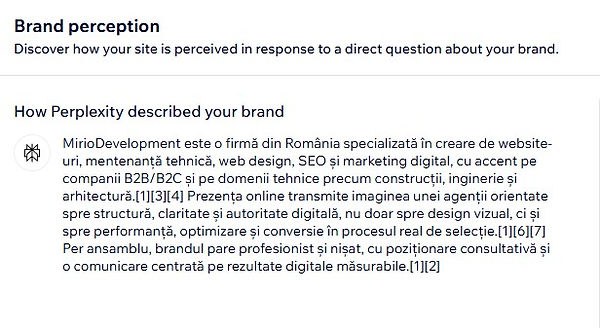
3. How AI Can Influence Brand Perception
Artificial intelligence can influence perceptions of a company through several informational mechanisms.
It can:
• briefly explain what the company does;
• summarize the services it offers;
• highlight its areas of expertise;
• place the brand in the context of a specific need;
• implicitly or explicitly compare multiple options;
• address common objections;
• suggest whether a company appears to be suitable for a particular situation.
This does not mean that AI is always correct. Its responses may be incomplete, may vary across platforms, and may depend on the information available. However, for the user reading the response, the impact can be significant.
If AI describes a company as well-documented, active, and specialized, it may encourage the user to continue their evaluation. If the response is unclear, contradictory, or lacking in detail, the company may appear less convincing, even if it has substantial real-world experience.
This is where the distinction between online presence and AI-interpreted digital reputation becomes important.
An online presence simply means that your company exists on the internet.
A reputation as interpreted by AI means that the information about your company is clear enough to be synthesized and presented in a useful and credible way.
4. Why the Official Website Is No Longer Enough
The website remains the core of a company's digital presence. It is the official source where the business can present its services, projects, expertise, team, and contact information.
However, in the age of AI, a website can no longer be treated as just a digital brochure.
Many websites rely on generic statements such as:
• “we offer comprehensive services”;
• “we are a team of professionals”;
• “we focus on quality”;
• “we provide customized solutions”;
• “we are results-driven.”
These claims may sound appealing from a marketing perspective, but they do not explain enough. They do not clearly show what the company does, how it works, who it serves, or which problems it solves.
A useful website in the age of AI should also function as a reliable source of documentation.
That means providing content that is clear, well-structured, explanatory, and regularly updated.
Promotional Website
States that the company is good.
Uses generic messaging.
Provides only brief descriptions of services.
Focuses primarily on selling.

Website Designed to Support Reputation in the Age of AI
Explains why the company is relevant for specific projects.
Provides details, examples, and context.
Explains problems, solutions, and decision-making criteria.
Focuses on understanding and building trust.
This distinction is essential. If a website does not provide sufficient explanations, AI systems may struggle to identify clear information about the company.
If the available information is incomplete, the generated summary may also be incomplete.
For a complementary perspective on this topic, see the MirioDev article:
5. How Contradictory Information Can Affect a Company's Reputation
A common issue in digital communication is inconsistency.
A company may have one description on its website, a different one in a business directory, another in an older press release, and yet another in an outdated public profile.
Individually, each piece of information may appear to be correct. Together, however, they can create confusion.
Examples of problematic situations:
Situation
The website presents current services, but business directories still list outdated ones.
External articles use inconsistent descriptions of the company.
Case studies are missing.
Only promotional content is available.
Information about the target audience is unclear.

Potential Impact
The brand may appear outdated.
AI may generate an inconsistent representation of the company.
The company's expertise may be difficult to verify.
The company may appear insufficiently documented.
AI may incorrectly describe the brand's target audience.
In the age of AI, consistency becomes increasingly important because generative systems can combine information from multiple sources.
If those sources are not aligned, the final response may be partially correct but still incomplete or confusing.
This is one of the most significant differences compared to traditional digital communication.
It is no longer enough to focus only on what the main website says. The entire information ecosystem surrounding the company now matters.
6. Why Explanatory Content Is More Valuable Than Promotional Content
Promotional content aims to persuade. Explanatory content aims to clarify.
When it comes to a company's reputation, clarity is often more valuable than promotion.
A potential client does not simply need to hear that a company is “professional.”
They need to understand:
• what the company actually does;
• who it works with;
• what types of problems it solves;
• what experience it has;
• what results it can demonstrate;
• how it compares with other available options.
This information is important not only for people but also for AI systems that aim to provide useful and informative answers.
Promotional Content
“We are a leader in our industry.”
“We offer premium services.”
“We provide comprehensive solutions.”
“We are results-driven.”

Explanatory Content
“We work with these types of companies and solve these specific challenges.”
“We explain what the service includes and the situations in which it is most appropriate.”
“We outline the differences between available options and the criteria for making an informed choice.”
“We present documented case studies and real-world examples.”
Guides, FAQs, comparisons, case studies, and educational articles help reduce uncertainty.
They enable users to better understand a company while providing richer context for interpreting and evaluating the brand.

7. The Role of External Validation, Interviews, and Case Studies
A company's reputation is not built solely on what it says about itself. Equally important is how the company is represented across relevant external sources.
External validation may include:
• editorial articles;
• interviews;
• public case studies;
• features in industry publications;
• mentions in relevant materials;
• reviews and testimonials;
• documented partnerships.
These sources do not replace the official website, but they complement it by providing additional confirmation, context, and real-world examples.
For users, external sources can strengthen trust. For AI systems, they can contribute to a clearer understanding of the brand, especially when their messaging is consistent with the information published on the company's website.
For an analysis of the stage in which a system may separately search for reviews, case studies, comparisons or other forms of validation, see what AI searches for before citing a website.
A relevant example from the MirioDev ecosystem is the case study on appearing in Google AI Overview:
This type of content is valuable because it goes beyond general claims.
It documents a specific context, a measurable outcome, and a clear progression.

External validation should, however, be managed carefully.
If articles published outside the official website use inconsistent messaging or are not fully aligned with the company's positioning, they may produce the opposite effect: confusion, message dilution, or inaccurate interpretations.
8. How to Check What AI Says About Your Company
An important step for any brand is to evaluate how it is represented by AI systems.
This assessment should not be limited to searches using only the company name. It is also useful to ask the kinds of questions that a potential client might ask.
Examples:
• What does this company do?
• Is this company the right fit for my project?
• What services does it offer?
• What are its main strengths?
• What makes it different from its competitors?
• What alternatives are available?
• Which company would you recommend for this need?
• Is this company trustworthy?
It is important to perform these tests across multiple platforms, as the responses may vary.
ChatGPT, Gemini, Google AI Mode, Perplexity, and Claude may interpret the same information differently depending on the sources they can access and the way they generate their responses.

The goal of these checks is not to obtain a perfect response.
The goal is to identify potential issues such as:
• missing information;
• inaccurate descriptions;
• omitted services;
• unclear positioning;
• outdated external sources;
• lack of examples;
• lack of external validation.
Once these issues have been identified, the company can take action by updating its content, publishing explanatory materials, clarifying its messaging, and building a more coherent information ecosystem.

9.Recommendations for Brands That Want to Be Understood, Cited, and Recommended
For a company to be better understood in the age of AI, simply publishing more content is not enough.
What truly matters is the quality, clarity, and consistency of that content.
9.1. Explain Your Services in Clear Language
Each important service should have a dedicated page or a well-developed section explaining:
• what it includes;
• who it is intended for;
• when it is appropriate;
• what problems it solves;
• what results can realistically be expected;
• how it differs from other available solutions.
9.2. Update Outdated Content
Outdated information can negatively affect how a brand is perceived.
If services have changed, the portfolio has expanded, or the company's positioning has evolved, its publicly available content should be updated accordingly.
9.3. Publish Case Studies
Case studies demonstrate real-world experience. They can show how a company thinks, how it approaches projects, and what results it is able to document.
For a practical perspective on documenting digital projects, you can also explore the MirioDev case study on the development of a professional website: What Does Professional Website Development Mean in Practice?
9.4. Use Real FAQs
Frequently Asked Questions (FAQs) are important because they reflect the way users search for information.
They can help both visitors and AI systems better understand the context surrounding your company, services, and expertise.
9.5. Build External Validation
Editorial articles, interviews, and features in relevant publications can complement the information available on your website.
However, they should reinforce the same overall positioning rather than create conflicting or parallel messages.
9.6. Monitor AI Responses Regularly
These checks should be repeated on a regular basis, especially after:
• launching new services;
• publishing case studies;
• changing the company's positioning;
• the publication of external articles;
• updating the website.
Action
Updating service pages
Publishing guides
Case studies
FAQs
External validation
AI monitoring
Benefit
Reduces the risk of outdated information
Improves understanding
Demonstrates real-world experience
Answers specific questions
Strengthens credibility
Quickly identifies perception issues
10. Conclusion
AI does not create a company's reputation from scratch. Instead, it synthesizes information that it can find, understand, and consider relevant to the user's question.
For this reason, companies that communicate vaguely, rely on outdated content, or fail to clearly document their activities may be represented incompletely. By contrast, brands that clearly explain what they do, publish useful resources, document their projects, and maintain a consistent digital presence are more likely to be understood accurately.
Reputation in the age of AI is not just about visibility. It is about clarity, consistency, credibility, and the ability to be understood by both people and the systems that increasingly mediate the research and decision-making process.
For companies that want to turn this direction into a structured strategy for building digital authority, the next step is understanding the relationship between explanatory content, AI Trust, and being cited by AI systems: How to Be Cited by AI?
11. Frequently Asked Questions
Can AI Influence a Company's Reputation?
Yes. AI can influence a company's reputation through the way it synthesizes and presents publicly available information.
If a potential client receives a clear and credible response, they may continue their research with greater confidence.
If the response is confusing or incomplete, however, their initial perception of the company may be negatively affected.
Does AI Rely Only on a Company's Official Website?
Not always.
Depending on the platform and the context, AI systems may use information from multiple public sources, including websites, articles, case studies, interviews, public profiles, reviews, and other content available online.
Why Is Explanatory Content Important for Reputation in the Age of AI?
Explanatory content helps reduce ambiguity.
Rather than relying solely on promotional claims, it answers users' real questions and provides meaningful context.
This can contribute to a clearer and more accurate understanding of the company.
What Are the Risks of Having Contradictory Information About a Company?
Contradictory information can lead to an inconsistent brand image.
If the website communicates one message, external articles present another, and public profiles are outdated, both users and AI systems may develop an inaccurate understanding of the company's actual activities.
How Can a Company Check What AI Says About It?
A company can periodically test the responses generated by ChatGPT, Gemini, Google AI Mode, Perplexity, and other AI platforms by asking questions similar to those a potential client might ask.
It is important to evaluate both brand-specific searches and broader questions related to services, expertise, and recommendations.
Is Having a Well-Optimized SEO Website Enough?
No.
SEO remains important, but in the age of AI it must be complemented by clear, explanatory, up-to-date content supported by credible external sources.
A website that is technically well optimized but lacks meaningful explanations may not provide enough information for AI systems to represent the brand accurately and comprehensively.
How Can a Company's Reputation Be Improved in the Age of AI?
By updating content, clearly explaining services, publishing guides, documenting projects through case studies, using real FAQs, building external validation, and periodically monitoring AI-generated responses.