


What Does AI Search for Before Citing a Website?
Over the past few months, we have analyzed several components of the same process on MirioDev.ro:
why some companies appear in AI-generated answers while others do not;
why a website can be indexed by Google but not cited by AI;
how an AI system can describe a company inaccurately or incompletely;
how AI influences a brand's reputation;
how AI Visibility can be measured;
the role of Digital Authority, GEO and AI Trust;
how a company's content can become a source used by ChatGPT, Gemini, Perplexity or Google AI Overviews.
All these resources started from the observable outcome: whether a company is mentioned, described, recommended or cited in an AI-generated answer.
Query fan-out allows us to examine an earlier stage. Before citing a source, an AI system may transform the user's question into several secondary searches, each focused on a different component of the topic.
A citation shows which source was selected. Query fan-out reveals part of what the system searched for before making that selection.
For MirioDev, this mechanism does not change the direction developed so far. On the contrary, it explains more clearly why an isolated guide is not enough and why the published content has been developed as an ecosystem of PILLAR pages, supporting articles, case studies, frequently asked questions, external validation and internal linking.
What You Will Find in This Article
What query fan-out means and where it occurs in the search process;
How the concept can be applied directly to the content published on MirioDev.ro;
The role of each guide, article and case study in covering secondary questions;
How fan-out complements AI Visibility analysis and measurement;
What the MirioDev and Unilux case studies reveal about topical coverage;
What international research into five million query fan-outs, RRF and Reddit can tell us;
What should be analyzed before automatically publishing new content.

Table of Contents
What is query fan-out?
What does AI search for before citing a website? A direct application
How the MirioDev ecosystem covers the branches of this question
What query fan-out adds to AI Visibility measurement
What we can learn from the MirioDev and Unilux case studies
What the analysis of five million query fan-outs confirms
RRF and the role of editorial architecture
Reddit, reputation and external sources
How a MirioDev AI Visibility audit should be extended
What this means for the content already published
Frequently asked questions
Conclusion
1. What Is Query Fan-Out?
Query fan-out is the process through which an AI system breaks down a user's question into several related searches. These searches may look for definitions, selection criteria, comparisons, examples, costs, reviews, risks, recent sources or evidence of experience.
Google officially defines query fan-out as a set of related queries generated simultaneously by the model to obtain additional information and relevant results.
In its official guide to optimizing websites for generative features in Google Search, the company states that AI Overviews and AI Mode use this mechanism to explore multiple components of the initial question. However, Google also warns that publishing separate pages for every possible query variation solely to influence AI results may fall within the scope of scaled content created to manipulate rankings.
OpenAI states that ChatGPT can decide whether to search the web based on the question, but this presentation does not disclose the exact architecture used to formulate, combine and rank all secondary searches.
Query fan-out does not work identically for every question or every platform. Sometimes the system only reformulates the initial request. In other cases, it searches for several components of the decision at the same time.
The process can be summarized as follows:
The user asks a question.
The system interprets the intent.
The question is reformulated or expanded into related queries.
Different information and source types are searched.
The results are evaluated and synthesized.
The answer is generated, sometimes with citations.
This sequence explains why citation tracking alone is not enough to identify the cause of an absence. If a company does not appear in the answer, the problem may occur before the citation stage: the company is not present for the secondary searches, does not cover the type of information being sought or does not appear in the sources the system uses for validation.
2. What Does AI Search for Before Citing a Website? A Direct Application
One of the central questions within the MirioDev ecosystem is:
How can a company's content become a source used and cited by AI systems?
At first glance, the question appears to require a single answer. In reality, it contains several distinct problems. A system attempting to build a well-documented answer might search for information such as:
what AI Visibility means;
what Generative Engine Optimization is;
how AI systems select sources;
why some websites are not cited;
the role of SEO;
what Digital Authority means;
how AI Trust is built;
why external sources matter;
how citations can be measured;
which case studies demonstrate observable results;
how ChatGPT, Gemini and Perplexity differ;
what a GEO strategy cannot guarantee.
This list is not a set of query fan-outs extracted from a single ChatGPT session. It is an editorial mapping of the secondary topics contained within the question.
Viewed in this way, the topic "How to get cited by AI" cannot be covered fully by a short article. It requires a central page and additional resources that separately develop the causes, measurement, reputation, validation and practical examples.
This is precisely the architecture that MirioDev.ro has begun to build.
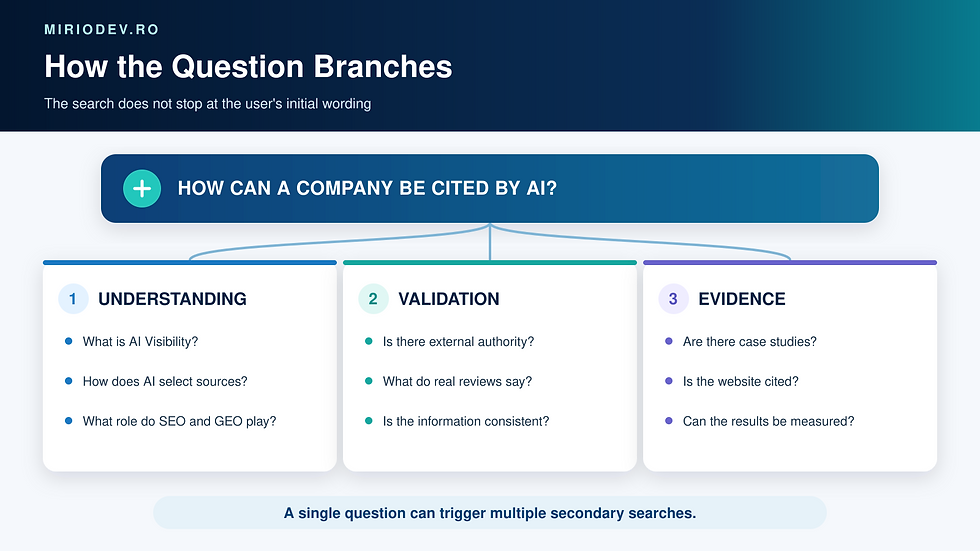
3. How the MirioDev Ecosystem Covers the Branches of This Question
The published content is not a collection of independent articles. Each resource addresses a different stage in the process through which a company can be discovered, understood, evaluated and used as a source.
Information need | MirioDev content | Role within the ecosystem |
How can a website be cited? | PILLAR page bringing together SEO, GEO, Digital Authority and AI Trust | |
What is AI Visibility? | Defines the relationship between authority, understanding, mentions and recommendations | |
Why is a website not selected? | Analyzes the difference between indexation and the ability to become a source | |
Why do some companies appear while others do not? | Explains informational relevance, content structure and validation | |
How is the brand interpreted? | Connects public sources, consistency and external validation with the reputation interpreted by AI | |
Why do incorrect descriptions appear? | Identifies missing information, contradictions and differences between platforms | |
How is the outcome measured? | Separates visibility, accuracy, citations, recommendations and AI Trust | |
Are there documented results? | Documents the development of MirioDev's own information ecosystem | |
Does it work in a specialized field? | Presents the development of an information architecture for built heritage | |
How do AI platforms differ? | Compares the same set of non-branded questions across three different systems |
This mapping shows the difference between content volume and topical coverage.
The new information about query fan-out does not mean that MirioDev should publish dozens of articles repeating the same explanations. It shows that existing resources should be analyzed according to the secondary questions they cover and the paths through which an AI system can reach them.
The How to Get Cited by AI page remains the explanatory center. Supporting articles address distinct problems. Case studies add evidence. The reputation guide develops the areas of consistency and external validation.
The measurement article turns outcomes into comparable indicators.Query fan-out explains why this separation is useful.
4. What Query Fan-Out Adds to AI Visibility Measurement
In the article How to Measure AI Visibility, the MirioDev methodology separates several indicators:
AI Visibility;
Coverage;
Brand Accuracy;
Website Citation;
AI Citation Score;
Recommendation Score;
AI Trust Score.
These indicators analyze the outcome produced by the platform: whether the brand appears, how frequently it appears, how it is described, whether its website is cited, whether it is recommended and how consistent the information used by the system is.
Fan-out introduces an earlier question:
For which secondary searches did the brand have an opportunity to be discovered?
This additional layer helps explain differences between the indicators.
A Practical Example
A company may have a strong page describing its service but still be absent from answers to recommendation questions.
Citation tracking only shows the absence. Query fan-out analysis may reveal the cause:
the system searches for a comparison, but the company has no comparative content;
it looks for reviews or external validation, but only claims published on the company's own website are available;
it searches for a case study, but the projects have not been documented;
it looks for current information, but the page has not been revised;
it searches for a technical criterion, but the content remains commercial and generic;
it looks for experience in a specific situation, but the service is presented without concrete applications.
In this context, the analysis follows this sequence:
question -> query fan-out -> source type -> brand presence -> answer -> citation -> recommendation
This sequence does not replace the MirioDev methodology. It makes it more explanatory. Citation Score shows what happened. Fan-out analysis may indicate why it happened.
5. What We Can Learn from the MirioDev and Unilux Case Studies
The case studies published so far did not directly track every branch generated for each question. We therefore cannot claim that query fan-out produced the documented results.
We can, however, observe that the architecture developed in these projects follows the logic of this mechanism: several secondary questions are covered by different but interconnected pieces of content.
5.1. MirioDev's Own Ecosystem
The MirioDev website was launched between August and September 2023 and was already functional, optimized and accessible to search engines. The explicit direction focused on the relationship between content, GEO, AI Trust, Digital Authority and citations by AI systems became visible within the ecosystem in May 2026.
The Google AI Overview Case Study - MirioDev documents the appearance of MirioDev content in Google AI Overview answers and the subsequent development of several interconnected resources.
The result cannot be attributed to a single article. The ecosystem includes definitions, explanations, distinctions between concepts, causes of absence from AI answers, reputation, measurement and case studies.
From a fan-out perspective, the value does not lie only in the number of pages. It lies in the fact that the topic can be approached from several directions without the positioning changing from one page to another.
5.2. Unilux Heritage
For Unilux Heritage, the content was developed around the restoration of historic windows and the built heritage sector. The ecosystem was not limited to a commercial presentation page. It included explanations, technical criteria, decision-support content and case studies connected to a clearly defined area of expertise.
The first appearances in Google AI Overviews were observed in March 2026, approximately one month after development of the ecosystem began. The same set of 18 non-branded questions was subsequently tested in ChatGPT, Gemini and Perplexity.
The documented results differed:
Platform | Observed AI Visibility |
ChatGPT | 22% |
Gemini | 28% |
Perplexity | 56% |

These percentages do not evaluate the quality of the company and do not guarantee commercial results. They indicate how frequently Unilux Heritage was used, mentioned or associated with the analyzed topics within that specific set of questions.
For the purpose of this article, the difference between platforms is important. The same information ecosystem does not produce the same visibility everywhere. Platforms may formulate different searches, use different sources and assign different importance to the content they retrieve.
6. What the Analysis of Five Million Query Fan-Outs Confirms
A Peec AI analysis, published in May 2026, examined five million query fan-outs collected between April 1 and April 21 from ChatGPT, Perplexity and Grok. Most of the data came from ChatGPT.
The study shows that systems can introduce terms that did not appear in the initial question. Among the terms most frequently added to the analyzed ChatGPT fan-outs were:
Term | Reported share |
best | 15.33% |
review / reviews | 6.84% |
the year 2026 | 5.44% |
top | 5.24% |
comparison | 4.48% |
vs | 4.27% |
These findings support several directions already present in MirioDev content.
The terms "best", "comparison" and "vs" confirm the importance of decision-support content, not only informational content. A potential client is not looking only for definitions. They want to understand differences, criteria and whether a solution is appropriate for their specific situation.
"Reviews" supports the role of reputation, external validation and real experiences. The article How AI Influences a Company's Reputation already explains why an official website cannot control the image synthesized by AI on its own.
The addition of the current year supports the need to update content. For MirioDev, this does not mean artificially changing the publication date. It means reviewing guides and articles when new data, platforms, methodologies or results emerge.
The study also identified differences in volume between platforms: an average of 1.4 fan-outs for Perplexity, 2.1 for ChatGPT and 6.8 for Grok within the analyzed dataset. These figures are not fixed rules, but they support a conclusion already demonstrated by the Unilux study: the same question and the same content can produce different results from one platform to another.

7. RRF and the Role of Editorial Architecture
Based on research conducted by Metehan Yesilyurt, Peec AI states that ChatGPT uses Reciprocal Rank Fusion (RRF) to combine the results obtained from multiple searches.OpenAI has not published an official confirmation of the exact implementation used in the product, so this claim should be treated as the result of external analysis.
RRF is a method for combining multiple ranked result lists. It was introduced in 2009 by Gordon V. Cormack, Charles L. A. Clarke and Stefan Buettcher in the paper Reciprocal Rank Fusion Outperforms Condorcet and Individual Rank Learning Methods.
Applied to MirioDev content, the concept has two different implications.
7.1. A Comprehensive Page Can Address Multiple Fan-Out Queries
The How to Get Cited by AI guide covers Digital Authority, SEO, GEO, AI Trust, citable content, information infrastructure and external validation. If the same page is relevant to several secondary searches and appears in multiple result lists, it may benefit directly from a rank-fusion mechanism.
7.2. The Cluster Creates Multiple Entry Points
The articles about missing citations, reputation, incorrect descriptions and AI Visibility measurement address distinct intents. They can be discovered separately and can lead the user or the system towards the central page through internal linking.
An important clarification is necessary: RRF does not mean that all MirioDev pages automatically receive a shared score. The advantage of the cluster lies in broader coverage, topical consistency and the existence of multiple relevant resources. The direct benefit of RRF applies to documents that appear in the result lists being combined.
This distinction prevents an incorrect conclusion: the number of articles does not win. What matters is the genuine relevance of the pages to the questions formulated by the system.
8. Reddit, Reputation and External Sources
The Reddit figures come from a separate analysis and not from the Peec AI study. According to research published by Josh Blyskal and Brandon Punturo, the share of ChatGPT answers whose fan-outs explicitly included the term "reddit" increased from approximately 0.15% in January 2026 to 3.68% by the end of May. Within their dataset of approximately seven million recent citations, Reddit accounted for 8.5% of ChatGPT citations.
These figures belong to a specific period and methodology. They do not demonstrate that Reddit has the same importance for every field, language or type of question.
For the MirioDev methodology, the relevant signal is different: AI systems may intentionally search for experiences and validation that a company's website cannot provide on its own.
This conclusion connects directly with three resources already published:
How AI Influences a Company's Reputation, which analyzes external sources and contradictory information;
Why AI Can Describe Your Company Incorrectly, which shows how missing validation and outdated content can produce incomplete descriptions;
How to Get Cited by AI, which includes distributed authority and external validation within the information infrastructure.
The conclusion is not "publish on Reddit". The correct action depends on the fan-out query and the industry. If the system searches for reviews, real experiences matter. If it requests documentation, technical evidence matters.
If it adds "comparison", selection criteria matter. If it asks for recent information, content updates matter.
AI Trust is not built by creating an artificial presence in every channel. It is built through a credible presence in the sources appropriate to the type of information being sought.
9. How a MirioDev AI Visibility Audit Should Be Extended
Until now, the MirioDev methodology has tracked visibility, coverage, description accuracy, website citations, recommendations, the sources used and differences between platforms.
Fan-out analysis can be added between question selection and answer evaluation.
9.1. Selecting the Questions
The set should include branded and non-branded questions grouped by intent:
discovery;
understanding;
comparison;
selection;
reputation;
risk;
recommendation.
9.2. Observing the Fan-Out Queries
For questions that trigger search, the following elements are recorded:
added terms;
introduced criteria;
compared brands;
year or location;
types of sources searched;
domains mentioned explicitly;
differences between platforms and tests.
9.3. Mapping Existing Content
Each relevant fan-out query is compared with the assets already published:
service page;
guide;
supporting article;
FAQ;
comparison;
case study;
documented project;
external source;
review or testimonial.
At this stage, the analysis determines whether the information exists, is sufficient, needs to be updated or is completely absent.
9.4. Verifying the Outcome
Only after the path has been mapped should the following be analyzed:
brand appearance;
Brand Accuracy;
cited page;
AI Citation Score;
Recommendation Score;
competitor sources;
consistency across ChatGPT, Gemini, Perplexity and Google AI.
9.5. Determining the Action
The result of the audit should not automatically be "publish a new article". The correct action may be:
consolidating an existing page;
expanding a section;
updating information;
correcting a contradiction;
developing a case study;
improving internal linking;
obtaining external validation;
documenting the service more clearly;
monitoring a source that influences reputation.

10. What This Means for the Content Already Published on MirioDev.ro
Applied to its own ecosystem, fan-out analysis leads to several concrete conclusions.
10.1. Existing Content Already Covers the Main Layers
MirioDev has a PILLAR page about AI citations, a guide to Digital Authority and AI Visibility, articles dedicated to the causes of absence, content about reputation and accuracy, a measurement methodology, and case studies covering both its own work and client projects.
The priority is not the automatic multiplication of these topics. It is the consolidation of the relationships between them.
10.2. The Role of This Article Within the MirioDev Ecosystem
The article about query fan-out occupies a distinct position:
How to Get Cited by AI explains the strategic foundation;
this article explains the search layer that precedes the citation;
How to Measure AI Visibility evaluates the observable outcome.
Internal linking between these three resources must be direct and contextual, not limited to a list of recommendations at the end.
10.3. Case Studies Must Be Connected to the Questions They Demonstrate
The MirioDev case study answers the question of whether an owned information ecosystem can produce observable results in Google AI Overviews.
The Unilux study on Digital Authority and AI Trust explains the development of the ecosystem within a specialized field.
The ChatGPT, Gemini and Perplexity analysis shows that visibility must be measured separately on each platform and across a set of non-branded questions.
These resources should not be presented only as "case studies". They should be connected to the specific problems they document.
10.4. Updating Is More Important Than Repetition
When a new topic adds a relevant explanation, the central pages should be updated to integrate it. Query fan-out should be introduced into the guide about AI citations, the measurement methodology and the resources addressing absence from AI answers.
Not every article needs to repeat the entire definition. It is enough to explain the necessary connection and link to the resource that develops the topic in depth.
10.5. The Next Content Gap Should Not Be Assumed
Fan-out queries are variable. Before establishing a new editorial topic, the priority questions, the sources used and the existing content should be checked. Only the difference between what the system searches for and what MirioDev has already published can justify an addition.
This approach follows the principle already used in MirioDev strategies: reuse, update, consolidation and internal linking before the automatic production of new content.
11. Frequently Asked Questions
What Does Query Fan-Out Mean?
Query fan-out is the process through which an AI system transforms the user's question into several related searches.
Why Is It Important for AI Visibility?
Because it shows which searches and source types may precede the selection of a citation. If the brand is not present for these secondary searches, its absence may be determined before the final answer is generated.
Does Fan-Out Analysis Replace Citation Tracking?
No. Fan-out queries explain part of the discovery process, while citations show the outcome. Both should be analyzed together with mentions, description accuracy, recommendations and competitor sources.
Was MirioDev Content Built Based on Query Fan-Out?
Not explicitly. The architecture was developed around real questions, explanatory and decision-support content, Digital Authority, GEO, AI Trust and validation through case studies. Fan-out analysis now provides an additional framework through which this architecture can be understood and evaluated.
Does an Article Cluster Automatically Receive a Better Score?
No. A cluster provides multiple entry points and covers more intents, but the pages on a domain should not be assumed to receive an automatic shared score. Each resource must be relevant and sufficiently clear for the search in which it appears.
Should a Separate Article Be Published for Every Fan-Out Query?
No. A comprehensive page can cover several related searches. Separate content is justified when there is a distinct intent, a genuine need for greater depth or a different type of evidence.
Can Fan-Out Analysis Guarantee a Citation?
No. It can identify gaps and opportunities for improvement, but source selection depends on the platform, model, question, competition, time of testing and other criteria that the company does not control.
12. Conclusion
The articles published on MirioDev.ro have so far analyzed citations, visibility, reputation, accuracy, Digital Authority, AI Trust and outcome measurement.
Query fan-out adds the missing link between the user's question and the source displayed in the answer.
Applied to the MirioDev ecosystem, it explains why the topic "How to get cited by AI" required several interconnected resources:
the central guide defines the strategy;
supporting articles explain distinct problems;
the content about reputation analyzes external sources and consistency;
the AI Visibility methodology measures the outcome;
the case studies document implementation and differences between platforms.
The value does not come from the existence of multiple pages. It comes from the fact that each page answers a different question and that, together, they form a coherent picture of what MirioDev explains, applies and can document.
From this perspective, citations remain an important indicator, but they are no longer the first place to look for the cause.
First, we need to understand what the system searched for, which sources it considered necessary and whether the brand's information exists along that path. Only then can we correctly interpret why a company was cited, described, recommended or omitted.


