


Why Some Companies Appear in AI Responses and Others Don't
Updated: Aug 18
For more than two decades, online visibility was measured through a relatively simple set of indicators.
Companies focused on Google rankings, organic traffic, website visitors and the conversions generated through their websites.

Today, as Google AI Overview, ChatGPT, Gemini, Perplexity and other AI-powered systems begin to influence how people search for information, a new question is emerging:
Why do some companies appear in AI-generated responses while others do not?
This question matters because many organizations are beginning to realize that simply having an online presence no longer guarantees the same level of visibility that traditional search once provided.
A website may be indexed.
It may contain content.
It may present products or services effectively.
It may even achieve strong rankings in search engines.
And yet, it may remain completely absent from AI-generated responses.
The ability of a company to appear in AI-generated responses is influenced by many factors related to credibility, relevance, and available information. These principles are explained in detail in our Complete Guide to Build Digital Authority and AI Visibility.
The difference is not determined only when the final answer is generated. What AI searches for before citing a website shows what may happen earlier, when the question is expanded into definitions, comparisons, evidence and external validation.
An Important Shift in How People Search for Information
At Google I/O in May 2026, Google confirmed a direction that many specialists had already been observing.
Online search is becoming increasingly conversational.
Users are asking more complex questions.
They continue the discussion through AI Mode.
They request explanations, comparisons and recommendations.
In many situations, they are no longer looking only for links. They are looking for answers.
This shift is changing the way information is evaluated.
Traditional Model | AI-Powered Model |
Displays results | Generates answers |
Users compare sources | AI synthesizes sources |
Focus on clicks | Focus on understanding |
List of websites | Informational summary |
Traffic | Informational relevance |
For this reason, the simple existence of a webpage is no longer enough.
Information must be usable.
Online Presence Does Not Automatically Mean AI Relevance
Many companies still treat their website as a digital business card.
There is a company presentation.
There are services.
There are products.
There is a contact form.
All of these elements are useful.
But modern search systems often look for more.
They try to identify sources capable of answering real questions.
Online Presence | Website Usable as a Source |
Presents the company | Explains the topic |
Lists services | Answers questions |
States benefits | Provides arguments |
Lists products | Explains differences |
Promotes an offer | Clarifies decisions |
This distinction becomes increasingly important as users interact with AI-powered systems.

Not All Information Has the Same Value
Let's assume that two companies operate in the same industry.
The first publishes only commercial descriptions.
The second publishes explanations, comparisons, guides and case studies.
Both have content. But they do not have the same type of content.
When an AI system needs to answer a question, the second approach is usually easier to use.
Not because it is longer.
But because it is clearer.
Content that explains is often more valuable than content that simply makes claims.
The Difference Between Being Displayed and Being Used
For many years, the primary objective of SEO strategies was to appear in search results.
Today, a new dimension is emerging.
The ability of content to be used as a source.
Being Displayed | Being Used |
Result | Reference |
Link | Source |
Presence | Relevance |
Visibility | Trust |
Access | Understanding |
SEO remains important.
But SEO is no longer the only factor influencing the relevance of a source.
Why Many Companies Communicate for Themselves Rather Than for Their Audience
A common issue is that many websites are built from the company's perspective.
The company says:
we have experience;
we are professionals;
we provide complete services;
we offer modern solutions;
we have a dedicated team.
The user is looking for something different.
What the Company Says | What the User Wants to Know |
We have experience | How does this help me? |
We are professionals | Why should I choose you? |
We provide complete services | What exactly is included? |
We are market leaders | What makes you different? |
We offer modern solutions | When are they the right choice? |
This difference influences more than the user experience.
It also influences the ability of content to be used as an informational source.
What Type of Content Is More Difficult for AI to Use?
Not all content provides the same informational value.
In practice, certain types of content are more difficult to interpret and use.
More Difficult to Use | Easier to Use |
Slogans | Explanations |
Promotional copy | Guides |
Generic descriptions | Comparisons |
Service lists | Case studies |
Unsupported claims | Concrete examples |
Very short content | Contextualized content |
This is one of the reasons why more organizations are investing in educational and decision-support content.
Why Do Some Companies Appear in AI Responses More Frequently Than Others?
Discussions about AI are often dominated by theory.
Real-world examples are usually far more interesting.
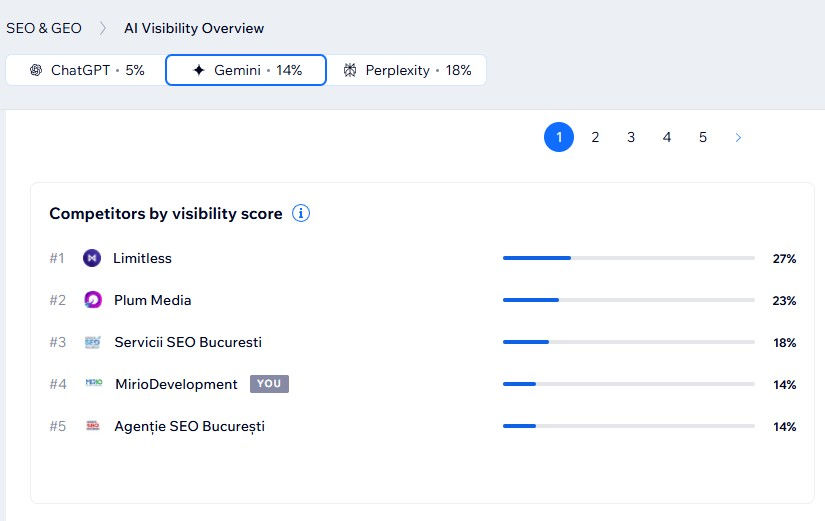
Within the Mirio Development ecosystem, several observable signals already suggest that a coherent informational infrastructure can generate measurable outcomes.
Observation | Documented Status |
Appearances in Google AI Overview | Yes |
Presence in ChatGPT | Yes |
Presence in Gemini | Yes |
Presence in Perplexity | Yes |
These observations should not be interpreted as guarantees of results.
They do not prove the existence of a universal formula.
However, they do suggest that modern search systems increasingly rely on content that explains, clarifies and answers real questions.
An Example from the Construction Industry
A relevant example can be seen in the Unilux Construct project.
By developing an informational structure built around decision-support content, thematic pages and genuinely useful articles, the website began to gain relevance for specialized searches related to heritage building windows.
This was not a campaign focused solely on keywords.
It was the development of an informational ecosystem designed to answer real user questions.
Read the Unilux Case Study: Digital Authority and AI Trust Growth
A Recent Example Observed in Google AI Overview
More recently, the Mirio informational ecosystem began appearing in Google AI Overview for searches related to SEO, GEO, Digital Authority and AI Trust.
This should not be interpreted as a promise of results.
It does not prove the existence of a universal formula.
It does not guarantee that other websites will achieve the same outcome.
However, it does represent a concrete observation of how well-structured content can become relevant within the new AI-powered search experiences.

What Companies Need to Understand
For many organizations, the website is still treated as a digital brochure.
There are a few pages.
There is a company presentation.
There is a contact form.
There is a list of services.
But modern search is beginning to demand more.
Not just presence.
Not just promotion.
Not just keywords.
But content that can be understood, evaluated and used.
The important questions are becoming:
Do we clearly explain what we do?
Do we answer the real questions our market is asking?
Do we provide context that supports decision-making?
Do we publish examples and case studies?
Are we building informational trust?
Companies that can answer "yes" to these questions are more likely to build long-term relevance.
Conclusion
Some companies appear in AI-generated responses while others do not because online presence alone is no longer enough.
A website must do more than simply exist.
It must explain.
It must clarify.
It must answer.
It must help build trust.
As Google AI Overview, ChatGPT, Gemini and Perplexity continue to reshape how people search for information, the difference between a website that is merely displayed and one that can be used as a source will become increasingly important.
For companies looking to better understand this topic, we also recommend our guide:


