


How Do AI Recommendations Influence Website Visits?
Similarweb studies show how an AI recommendation can influence subsequent website visits through Google and why attributing these results remains challenging.

A potential customer asks ChatGPT, Gemini, Perplexity, or another AI system which solution best meets their needs. They receive several names and recommendations, close the conversation, and do not click on any links.
Two days later, they search Google for the company they remember and visit its website. In the traffic report, Google is recorded as the source of the visit. But where did their interest actually begin?
This raises a practical question for any company trying to understand the results of its digital investments:
Which channel actually influenced the customer's decision?
Do AI recommendations generate more website visits? A study published by Similarweb in June 2026 provides useful data to help answer this question, but its findings must be interpreted in the context of the markets and users analyzed.
What You Will Find in This Article
What did Similarweb measure, and what does the 2.5x result actually mean?
Why are AI and Google Search often part of the same customer research journey?
What do the data reveal about website visits, engagement, and conversions without making misleading comparisons?
What role do specialized industry portals play in B2B research and decision-making?
What can we verify in Romania, and what cannot automatically be attributed to artificial intelligence?
The connection between AI Visibility, measurement, and our October 2026 case study.
Table of Contents
1\. How Can AI Recommendations Influence Website Visits?
2\. What Did Similarweb Measure About AI Recommendations?
3\. Why Do Website Visits Come Through Google After an AI Recommendation?
4\. How Do Visitors Behave After Receiving an AI Recommendation?
5\. Why Is Attributing Website Visits to AI Difficult?
6\. AI Recommendations and the B2B Customer Journey in Romania
7\. What Does the Mirio Development Assessment Reveal About AI Visibility?
8\. Conclusion: What Do We Know About AI Recommendations and Website Visits?
1. How Can AI Recommendations Influence Website Visits?
In traditional website traffic analysis, we examine traffic sources: organic search, direct visits, advertising, other websites, and, more recently, AI platforms. This information is essential, but it usually identifies the channel through which a visit occurred, not all the interactions that preceded it.
A response from ChatGPT can influence a user's interest without generating a click. The user remembers a company name, searches for it later on Google, compares two products, and visits the website through an organic search result. In the analytics data, that visit is recorded as search traffic.
However, there is no automatic proof that the earlier AI conversation was the decisive factor.
This distinction is also examined by Rob Tindula, Director of SEO at NP Digital, in an article published on NeilPatel.com.
The article highlights the limitations of last-click attribution: an analytics system may credit Google for a website visit that was preceded by discovering the brand through AI.
This illustrates a measurement challenge, not proof that every visit from Google originates from an AI interaction.
2. What Did Similarweb Measure About AI Recommendations?
The Similarweb study on the downstream impact of AI recommendations, published on June 23, 2026, tracked the actual journeys of users in the United States who requested recommendations from ChatGPT. The analysis covered three sectors: finance, travel, and beauty products.
The researchers tracked visits to recommended brands' websites over the following seven days.
To reduce the influence of pre-existing interest, they excluded users who had mentioned the brand in their query or had previously visited the relevant website.
According to Similarweb, the data covered US desktop users between July and December 2025.
How Should We Interpret the 2.5x Result?
The key finding: users who received a brand recommendation from ChatGPT were, on average, 2.5 times more likely to subsequently visit that brand's website than users who had been recommended a competitor.
This compares the likelihood of a website visit within the analyzed sample. It is not a promise that every company will increase its website traffic by 2.5 times.
The same finding was examined on June 23, 2026, by Search Engine Journal, which also emphasized the correlational nature of the data. The research does not establish that every visit was caused exclusively by an AI recommendation.
What Was Examined | Key Limitation |
Brand recommendations in ChatGPT | Not all AI systems |
US desktop users | Excludes mobile traffic and the Romanian market |
Finance, travel, and beauty | Not applicable to all types of B2B companies |
Website visits within 7 days | Does not measure inquiries or signed contracts |
3. Why Do Website Visits Come Through Google After an AI Recommendation?
The most interesting finding is not just how likely users were to visit a website, but how they reached it.
According to Similarweb, 55.9% of AI-influenced visits came through search, compared with 40.4% of visits without identified AI influence. The difference is 15.5 percentage points.

Important: The 55.9% figure refers to visits arriving through search. It should not be interpreted as a percentage of all ChatGPT users or of all website visits across the internet. Similarweb explains that a significant part of this behavior involves users returning to search for a brand by name.
Google and AI Within the Same Customer Research Journey
On October 14, 2026, Similarweb published an additional analysis examining what happens after AI recommends a brand. This research provides further insights into the role AI plays throughout the customer research process, rather than focusing solely on the final website visit.
Metric Reported by Similarweb | What It Measures |
76.1% of sessions involving AI | AI appears during the research and comparison stage, rather than at the beginning or end of the session. |
89% of AI-involved commercial journeys | Among the analyzed US desktop shopping journeys that involved AI before reaching a commercial website, users also relied on traditional search. |
These two percentages describe different groups and stages of the customer journey. They do not mean that 89% of all ChatGPT users subsequently search on Google, nor that AI caused every search.
Instead, they illustrate why treating AI traffic and Google search traffic as entirely separate channels may overlook part of the actual research process.
In practice, a business manager may notice an increase in branded searches without having enough information to determine how much of that growth comes from AI recommendations, marketing campaigns, previously read articles, personal recommendations, or a combination of multiple interactions.
4. How Do Visitors Behave After Receiving an AI Recommendation?
The analysis cited by Search Engine Journal also reveals differences in user behavior after arriving on a website. In the AI-influenced group, visitors viewed an average of 12 pages and spent approximately 11.8 minutes on the website.
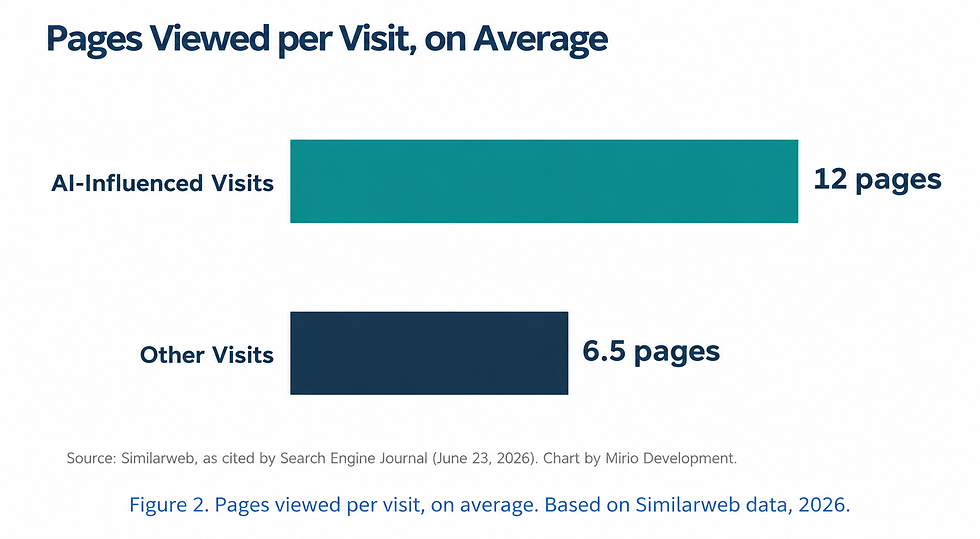
In the comparison group, the averages were 6.5 pages and 5.6 minutes.

More Time on a Website Does Not Automatically Mean More Sales
The differences may indicate greater interest among visitors in the analyzed group. However, we cannot conclude from these averages alone that AI recommendations directly caused higher engagement. The industry, type of website, user needs, and other variables that were not fully isolated must also be considered.
A longer website visit does not necessarily translate into a purchase. On a website offering technical documentation, a visitor may explore multiple pages without being ready to request a quote; on a website with a clearly defined offer, a few minutes and a single form may be enough.
Conversion Data Come from a Separate Analysis
Similarweb's October 14 analysis also presents conversion rates for US desktop shopping journeys observed in June 2026. These figures come from a separate analysis, distinct from the study examining specific brand recommendations and subsequent website visits within seven days.
Type of Customer Journey Analyzed | Conversion Rate |
AI and traditional search | 23.0% |
Traditional search only | 17.3% |
AI only | 12.5% |
Source: Similarweb analysis published on October 14, 2026.
The figures show an association between the type of customer journey and conversion rates within the analyzed group. They do not demonstrate that including AI independently causes higher conversion rates, nor can these rates be automatically applied to B2B companies in Romania.
5. Why Is Attributing Website Visits to AI Difficult?
Three Mistakes in Attributing Website Visits
The first mistake is assuming that only visits directly attributed to ChatGPT, Gemini, Perplexity, Copilot, Claude, Grok, DeepSeek, or another AI platform represent the value of an AI recommendation.
These visits account only for the traffic with an identifiable referral source.
The second mistake is the exact opposite: attributing every increase in branded searches to artificial intelligence. Branded searches can be influenced by many other activities, including marketing campaigns, recommendations, events, media coverage, or direct sales activities.
The third mistake is combining different metrics. A company being mentioned in an AI-generated response, an article being cited, and a customer submitting an inquiry are distinct stages.
One may precede another, but the relationship must be documented rather than assumed.
In our Mirio analysis on measuring AI Visibility, we explain separately what each metric can measure and verify.
Observation in the Data | What We Can Conclude |
The brand appears in AI-generated responses | The brand has visibility across the monitored queries |
Branded searches increase | There is additional interest, but its source has not been established |
Website visits come from Google | Search is the traffic channel, but not necessarily the original source of discovery |
More inquiries are generated | Conversion analysis and examination of the customer journey are required |
6. AI Recommendations and the B2B Customer Journey in Romania
We cannot automatically apply the findings of the Similarweb study to a Romanian company selling industrial equipment, construction materials, or professional services. The purchasing process is different, often involving multiple decision-makers, extended research periods, and purchases completed offline.
However, the underlying mechanism is worth considering. An architect may discover a manufacturer's name in an AI-generated response, search for it later on Google, and use its technical documentation in a project. The construction company may place an order several months later. This is an illustrative scenario, not a documented conversion.
There are also situations where a customer does not search for the brand directly but returns to a website after encountering the same information across several sources. From a business perspective, it would be a mistake to credit only the last touchpoint. From an analytical perspective, it would be equally misleading to claim that all previous interactions caused the sale.
The Role of Niche Industry Portals in Customer Research
In the construction industry, research extends beyond the manufacturer's own website.
Specialized platforms such as SpatiulConstruit.ro and Arhispec.ro bring together products and services, suppliers, projects, and specialized information related to Romania's construction industry.
An architect, design engineer, or potential customer may discover a solution through these platforms and subsequently verify it directly on the supplier's website.
For suppliers, the advantage is access to an audience specifically interested in their industry, rather than exposure to general website traffic.
Being featured on a professional platform independent of the company's own website can provide an additional point of reference: product or service descriptions, applications, technical documentation, or published projects can be consulted across multiple sources.
This information may contribute to a customer's research process and can also be discovered through traditional search or AI-generated responses.
This is precisely where the limitations of last-click attribution become relevant. A technical article read on a niche industry portal may influence a purchasing decision, even though the subsequent visit to the supplier's website is recorded in analytics as Google search traffic or a direct visit.
Such influence is possible, but it cannot be quantified solely through the number of visits from Google or an isolated AI recommendation.
We previously explored the difference between online presence and relevant commercial inquiries in our article on visibility and inquiries in the AI era.
This article adds another perspective: why certain interactions that influence customers before they visit a website remain invisible in conventional attribution reports.
7. What Does the Mirio Development Assessment Reveal About AI Visibility?
In the assessment conducted on October 22, 2026, based on 15 non-branded queries, Mirio Development was mentioned in 27% of the responses analyzed, while miriodev.ro was cited as a source in 45% of them. These figures measure brand visibility and source citations, not website traffic influenced by AI.

The Mirio Development case study published in October 2026 presents the assessment results and the supporting evidence.
It does not demonstrate that AI recommendations generated a specific number of website visits or contracts. For this reason, its findings should not be directly compared with the 2.5x figure reported by Similarweb.
Within a broader evaluation framework, these two perspectives can complement each other: monitoring AI-generated responses reveals where a brand appears, while analyzing subsequent user behavior can provide insights into user interest and actions. The relationship between them requires further analysis over sufficiently long periods.
8. Conclusion: What Do We Know About AI Recommendations and Website Visits?
AI recommendations can influence website visits even when users subsequently arrive through Google. If we measure only the final visit, we risk overlooking the role of the initial recommendation.
If we automatically attribute that visit exclusively to AI or Google, we risk making claims that go beyond what the data actually demonstrate.
Similarweb's research shows an association between ChatGPT recommendations and the likelihood of subsequent website visits among the users and industries analyzed. More recent data indicate that artificial intelligence is often used alongside Google, particularly during research and comparison.
These findings come from separate analyses and do not represent a forecast of any company's website traffic or sales.
For businesses, the practical conclusion is that visibility, website traffic, and commercial outcomes should be analyzed together but reported separately. Only then can we distinguish between what has been observed, what is likely, and what still needs to be verified.
Sources and Further Reading
Similarweb: The Impact of AI Recommendations (June 2026) | Similarweb: What Happens After an AI Recommendation (October 2026) | Search Engine Journal: Study Analysis (June 2026) | NeilPatel.com: The Challenges of Attribution (October 2026)


